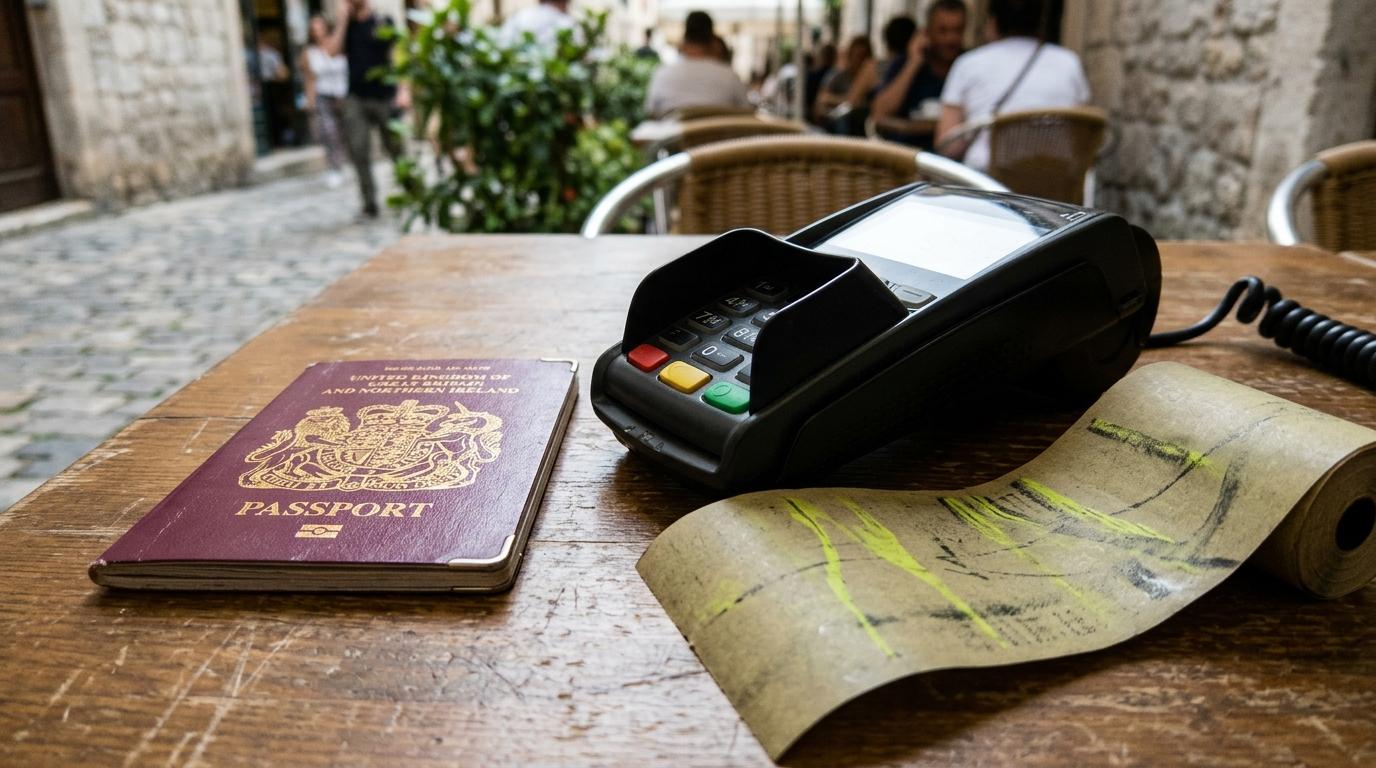
A card that stops working abroad is not always blocked. Often it is simply declined: a setting, a limit, a terminal. A genuine preventive block comes from a fraud detection system. It is lawful, the issuer has to tell you about it, and it is lifted with a call to the issuer, never to Card Stop.
Why is my card blocked abroad?
Because a transaction looked abnormal to a detection engine, in most cases. Not because your bank made a decision about you.
The engine compares every authorisation request with your history. A first payment in a country where the card has never been used, a cash withdrawal ten minutes later, then an online purchase from a foreign website in the middle of the night, Belgian time: each line on its own goes through, the sequence triggers the alert. The card is then blocked as a precaution. It no longer works anywhere, in shops or at cash machines, until someone has checked.
In the files I handled, this scenario came back every summer. The cardholder was acting in good faith, and so was the transaction. The block was still justified in the eyes of the law, and that is the point most people discover too late.
You still need to be sure the card is actually blocked.
Blocked or simply declined: how do you tell the difference?
A block makes the card unusable everywhere. A decline rejects one specific transaction, and the card itself is fine. The two look the same at the till, but not in the app.
Open your issuer's app before you call anyone. A blocked card usually shows up as blocked. A declined card shows a normal status, and the cause lies in the settings or the limits.
| Symptom | Likely cause | Who can unblock | Timing |
|---|---|---|---|
| Declined on one terminal, works elsewhere | terminal or local network, for example some cash machines in Japan with a Debit Mastercard according to Belfius | nobody, try another machine | immediate |
| Debit card declined everywhere outside Europe | usage zone limited to Europe by default | you, in the app | immediate |
| Declined above a certain amount | spending or withdrawal limit reached | you, in the app, or the issuer | immediate at KBC according to its page |
| PIN rejected three times | PIN locked | the issuer, under its own procedure | varies |
| Declined online, verification code never received | 3-D Secure, outdated mobile number | you, then the issuer | varies |
| Declined everywhere after an unusual transaction | preventive block for suspected fraud | the issuer's card service | as soon as the check is done |
| Declined in a sanctioned country | card excluded from that country by the issuer | nobody | never |
| Declined after late repayments | credit line suspended | the issuer | once arrears are settled |
Two rows in this table always surprise people. Belfius states that its debit card has not worked outside the European geographic zone since 17 January 2011, unless activated temporarily, for three months at most in the app. Beobank, on the page for its Visa Classic consulted on 24 November 2026, refers to a list of countries where the card does not work at all. No phone call changes either of those two declines.
Who decides on a preventive block, your bank or an algorithm?
An algorithm, then a person. And often not anyone at your branch.
Many Belgian issuers outsource transaction monitoring to Worldline. KBC says so on its lost card page, consulted on 24 November 2026: Worldline's "Fraud Control" service detects fraud, working with Mastercard. Belfius even has a help centre entry titled "Why did Worldline block my credit card?". Your bank adviser sees the block after the event, if at all.
A complaint published on Test-Achats, the Belgian consumer association, shows what it looks like from the cardholder's side. A Visa card obtained through Crelan, blocked twice in one month for "too many online purchases". No warning. The bank, which had not been informed either, could explain nothing, and the cardholder was told to make an in-store purchase to reactivate the card.
The issuer looks first at geographic consistency and the speed of transactions, then at the type of merchant. I used to read these alerts line by line. A withdrawal in Bangkok two hours after a payment in Liège is physically impossible, so it is a cloned card. A withdrawal in Bangkok the day after a flight out of Brussels Airport is a holiday. The engine knows nothing about your plane ticket.
The detection engine does not know you are on holiday. It only knows your card has never been used in that place.
Can my bank block my card without warning?
Yes, provided it tells you immediately afterwards at the latest. The wording of the law is precise.
Article VII.37(2) of the Belgian Code of Economic Law, whose Book VII is the Belgian statute governing payment services and consumer credit, was inserted by the Act of 19 July 2018 transposing Article 68 of the PSD2 directive. It allows the issuer to block the card if the contract provides for it. Three grounds are accepted, and they must be "objectively justified": the security of the card, suspected unauthorised or fraudulent use, and, for a card linked to a credit line, a significantly increased risk that you will be unable to repay.
The issuer informs you of the block and the reasons for it, "if possible before" and "at the latest immediately after". It is exempt only if giving that information would compromise objectively justified security reasons, or if another law prohibits it. It unblocks or replaces the card as soon as the reasons for the block no longer exist.
So the objection does not hold. A block with no prior warning is lawful. A block with no information at all, neither before nor after, is not, and that is what can be challenged. Suspending the credit line because of repayment risk follows a different logic, covered in the article on whether your bank can cancel or block your credit card.

How long does it take to unblock the card?
The length of a phone call, for a preventive block. Several days, if you have turned that block into a permanent one.
A preventive block is lifted once the issuer has checked your identity and you have confirmed or disputed the flagged transactions. The number to call is on the back of the card and in the app. Write it down before you leave, because a blocked card will not help you find it.
The trap is Card Stop, the Belgian 24/7 card blocking service. It blocks, it never unblocks, as explained in the article on what Card Stop does and does not do. The model letter published by Card Stop, dated 2021, mentions a new card within five working days, sent to the address the bank has on file. In Belgium, in other words. Wikifin, the financial education website run by the FSMA, the Belgian financial regulator, suggests asking your bank for urgent delivery to your holiday address, if it offers that service.
In the files I handled, the time lost rarely came from unblocking. It came from the number dialled. A worried cardholder would call Card Stop about a card that was merely suspended, and end up with a cancelled card thousands of kilometres from their letterbox.
Can an unjustified block be challenged?
Yes, but not on the grounds people expect. The law allows a block based on a suspicion, even a wrong one. A legitimate transaction blocked by mistake is therefore not, on its own, a fault on the issuer's part.
Three failings can be challenged, however:
- no information at all, neither before nor after the block;
- a block kept in place after the check has been made and the reason has gone;
- replacement fees charged for a card the issuer itself chose to cancel.
As for the cost of a disrupted trip (a hotel paid another way, taxis, cash exchanged at a bureau), the answer is no in principle: card terms and conditions almost always limit the issuer's liability. I do not know your contract and I do not give personal advice. The steps are the same in every case: a written complaint to the issuer's complaints department, with a timeline and screenshots from the app, then Ombudsfin, the Belgian ombudsman for financial disputes, which is free and whose opinion is not binding.
If the block reveals charges you did not make, a different procedure applies, described in the article on a hacked card.
Which backup card should you take, and at what cost?
A second card, issued by a different institution. Two cards from the same bank can go through the same monitoring centre, and fail together.
Before choosing one, read the three figures nobody reads: the annual fee, the APR on a carried balance, and the cost of a €100 cash withdrawal. A backup card is mainly used to get cash when the other one is blocked, and that is where it costs money.
| Card | Annual fee | APR on carried balance | €100 cash withdrawal | Price checked with the issuer on |
|---|---|---|---|---|
| Beobank Visa Classic | €5 | 14.49% | €5.00 (2.50%, minimum €5) | 24 November 2026 (rates in force on 9 May 2025), withdrawal fee checked on 3 October 2026 |
| Buy Way Mastercard One | €17.50 | 14.50% | €6.50 | 19 November 2026 (September 2025 guide) |
Over twelve months, it quickly adds up to more than the annual fee. Three emergency withdrawals of €100 with the Buy Way Mastercard One cost €19.50 in fees, €2 more than the annual fee. The calculation is mine, based on the prices above. Interest on a withdrawal comes on top, under the rules set out in the article on cash withdrawals with a credit card.
One point the brochure does not highlight: the cap. Beobank advertises up to €1,000 in withdrawals per 24 hours with the Visa Classic. At KBC, withdrawals above €650 a day are only possible at KBC and CBC cash machines. To compare other cards on the same three figures, see the Belgian credit card ranking, the comparison tool and the selection guide.
Before you leave: five settings to check in the app
A few minutes in the app before departure prevent a good share of the declines I used to see. In order:
- Open up the usage zone of your debit card if you are leaving Europe. Belfius allows this for three months at most in the app, and KBC offers a temporary exception to its standard region.
- Raise the limit if a large purchase is planned. KBC allows a temporary increase of the monthly credit card limit twice a year, for 30 days at most.
- Check the mobile number and email address on file, and switch on alerts. Beobank Alert sends free text messages or emails about card use. Without up-to-date details, the notice owed to you after a block reaches nobody.
- Write down your issuer's card service number, which is not the same as Card Stop. At a neobank such as Revolut, which is not part of Card Stop, you freeze and unfreeze the card yourself in the app, and an automated line on +32 460 23 65 81 lets you block it.
- Check the issuer's list of excluded countries if your destination is sensitive.
The rest depends on an engine nobody sees. A card opposition and a card block do not have the same effects, and a declined online payment is often a 3-D Secure issue rather than a block.
Sources, consulted on 24 November 2026 unless stated otherwise. Blocking of a payment instrument: Article VII.37(2) of the Code of Economic Law, inserted by the Act of 19 July 2018. Article 68 of Directive (EU) 2015/2366. Payment problems abroad and urgent card delivery: Wikifin (FSMA). Worldline Fraud Control service: KBC lost, stolen or retained card page. KBC limits and international use: card settings. Debit card outside Europe since 17 January 2011: Belfius, travelling outside Europe. Beobank Visa Classic, APR, withdrawal cap and excluded countries: product page, rates in force on 9 May 2025; withdrawal fees: Beobank price list checked on 3 October 2026. Buy Way Mastercard One: card guide, September 2025, checked on 19 November 2026. Revolut card freeze: Revolut help centre. Block without notification: public complaint on Test-Achats. Card Stop: cardstop.be. Mediation: Ombudsfin. Calculation on three withdrawals: the author, 24 November 2026. None of the links in this article are paid.
Comparator
Compare cartes de crédit side by side.
Compare now →
Frequently asked questions

Delphine a passé sept ans au service litiges et rétrofacturation d’un émetteur de cartes belge, à Liège, entre 2015 et 2022 : le bureau où atterrissent les contestations de porteurs, les retraits facturés deux fois et les cautions d’hôtel qui restent bloquées trois semaines. Elle a donc lu, ligne par ligne, plusieurs milliers de relevés de cartes belges, et elle sait où se logent les montants que personne ne regarde avant de signer. Depuis 2023 elle relève chaque trimestre les tarifs publiés des émetteurs belges et tient le tableau de coûts qui sert de base à ce site. Ce qui l’agace : les brochures qui annoncent une carte à 0 € sans mentionner que le premier retrait au distributeur coûte 5 € fixes plus 1,8 % de commission, et que les intérêts courent dès le jour du retrait.