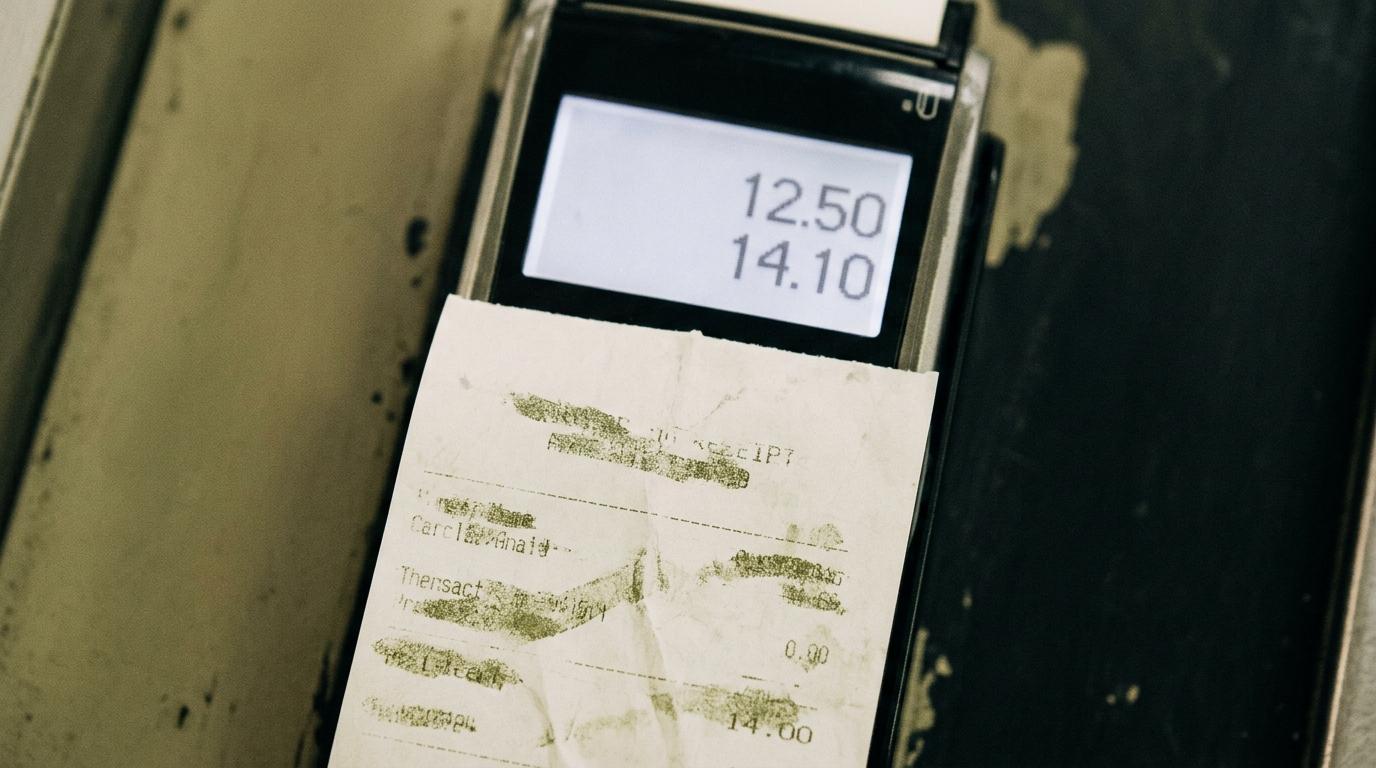
Pay in the local currency. When the terminal in a Prague restaurant or a London hotel offers to charge you in euros, it is selling you a conversion at the merchant's rate, with a markup between 2.6% and 12%. Your Belgian card issuer takes between 1.50% and 2.50%. The "pay in euros" screen is almost always the more expensive of the two.
Should I pay in euros or in local currency abroad?
In local currency. It is the only answer that held up in almost every case I saw.
The mechanism is called dynamic currency conversion, DCC for short. The terminal (or the cash machine) reads the card, sees it was issued in euros and offers to convert on the spot. If you accept, the transaction goes through in euros, at a rate set by the merchant's provider. If you decline, it goes through in koruna, pounds or dollars, and your issuer converts it at the ECB rate plus its own fee.
The choice costs you nothing. Declining the conversion does not cancel the purchase.
How much does the terminal's conversion cost?
A markup of 2.6% to 12% above the reference rate, averaging around 5%, according to a study published in 2023 in the Journal of Public Policy & Marketing. The markup does not appear as a fee line: it is built into the rate.
Against those markups, here is what three Belgian cards charge when the issuer does the conversion.
| Card | Annual fee | APR on a carried balance | Issuer's foreign exchange fee | €100 paid in local currency | Price checked with the issuer on |
|---|---|---|---|---|---|
| Belfius Visa Classic | €23.16 | not applicable, statement settled in full each month | 1.50% | €101.50 | 18 September 2026 |
| Beobank Extra Mastercard | €20.00 | 15.99% | 2.10% | €102.10 | 10 October 2026 |
| Buy Way Mastercard One | €17.50 | 14.50% | 2.50% | €102.50 | 19 November 2026 (September 2025 guide) |
And here is the same €100 purchase accepted in euros at the terminal, depending on the markup applied.
| Dynamic currency conversion markup | Amount debited in euros | Extra cost vs Belfius | Extra cost vs Buy Way |
|---|---|---|---|
| 2.6%, low end of the range | €102.60 | €1.10 | €0.10 |
| 5%, study average | €105.00 | €3.50 | €2.50 |
| 12%, high end of the range | €112.00 | €10.50 | €9.50 |
Over twelve months, it adds up. €1,500 of spending outside the eurozone accepted in euros at a 5% markup costs €75, against €22.50 in fees at Belfius and €37.50 at Buy Way. These gaps are my own calculations, based on the prices listed above.
The brochure does not highlight it, but the card's other figures do not vanish abroad. A €100 cash withdrawal costs €6.50 in fees at Buy Way, and the Beobank Visa Classic (€5 annual fee, 14.49% APR, rates in force on 9 May 2025, page checked on 20 November 2026) refers its withdrawal fees to the bank's price list. The foreign exchange fee and cash withdrawals are covered separately.
Does the terminal have to show the markup before payment?
Yes, inside the EU, and for an EU currency. Article 4 of Regulation (EU) 2021/1230 requires a provider converting at a cash machine or point of sale to express its charges as a percentage markup over the latest ECB reference rate, and to disclose it before payment. The terminal must also show the amount in the merchant's currency and the amount that will be debited from your account, and tell you that you can pay in the local currency.
The same rule requires your own issuer to send you an electronic message, without undue delay, stating its markup when you pay in an EU currency other than the euro. A payment in zloty, Czech koruna or forint triggers that message. Compare the two percentages: that is the written evidence you need.
Outside the EU, this text does not apply. The regulation covers transactions in euros or in the currency of a Member State. In New York, Bangkok or Zurich, only the Visa and Mastercard rules remain, and they require the choice to be offered without requiring the markup to be shown as a percentage. Article 59(2) of Directive (EU) 2015/2366, known as PSD2 and transposed into Book VII of the Belgian Code of Economic Law (the Belgian statute that governs payment services and consumer credit), sets the principle: whoever offers the conversion must disclose all charges and the rate, and you must agree to it.

Can I dispute a conversion that was forced on me?
Yes, if the conversion was imposed on you. No, if you chose it.
Visa has a dedicated dispute condition, 12.3, "Incorrect Currency". According to the sheet published by Visa, it covers three cases: the cardholder was not told about DCC or did not agree to it, the cardholder was not offered the option of paying in local currency, or the transaction currency differs from the one sent to the network. The merchant only wins by proving that you "actively chose" the conversion, receipt in hand. At Mastercard, the case falls under code 4834, "Point-of-Interaction Error".
In the files I handled, the deciding document was almost always the receipt. A DCC receipt normally shows the rate, the markup and an acceptance statement. When it showed none of these, the merchant lost. When it did and the cardholder had entered their PIN, the file stopped there, even with an 11% markup.
| Situation | Recourse | What you do |
|---|---|---|
| The euro screen came up on its own, with no choice | chargeback, Visa 12.3 or Mastercard 4834 | write to the issuer, attach the receipt |
| You declined, the payment still went through in euros | chargeback, same code | describe the refusal, with date and time |
| The waiter chose "euros" for you | chargeback, no consent | say so in writing, even without proof |
| You confirmed the euro screen, rate displayed | none | pay in local currency next time |
| Euro amount differs from the receipt | chargeback, incorrect currency | attach receipt and statement side by side |
| Markup not shown in an EU country | report it as well as disputing | SPF Economy contact point or ECC Belgium for a foreign merchant |
How long do I have to dispute it?
Not long. Published dispute guides give the issuer a maximum of 120 days at Visa, and 90 to 120 days at Mastercard depending on the case, counted from the processing of the transaction. That deadline is your bank's towards the network. Yours is shorter, because the bank has to examine the file before passing it on.
The issuer looks at the date first. A file opened after five months did not go anywhere, whatever its merits. The 13-month period in Book VII covers unauthorised or incorrectly executed transactions; a conversion you let through without refusing it does not fit easily into that box. Other deadlines are gathered in the article on the time limit to dispute a card payment.
For a complete file, gather:
- the terminal receipt, or a photo of it, showing the currency and the amount;
- the statement showing the transaction in euros;
- the ECB reference rate for that day, to put a figure on the gap;
- a dated note describing what happened: screen displayed, choice refused or never offered.
Can my bank charge a fee on top of the DCC?
It can, and it was the double charge I saw most often. Some price lists apply their fee to transactions "outside the eurozone", with no distinction by currency. The Buy Way Mastercard One guide uses that wording for its 2.50%. A payment converted into euros in London can then carry both the merchant's markup and the issuer's fee.
Ask your issuer in writing how it treats a payment denominated in euros at a merchant located outside the eurozone. If the answer does not satisfy you, Ombudsfin, the Belgian ombudsman for financial disputes, reviews the complaint free of charge, once a written complaint to the bank has gone unanswered. The full chargeback process is described in the article on chargebacks in Belgium, and the difference with a simple refund in the one on chargeback, refund and cancellation. To compare cards on their figures, see the Belgian credit card ranking and the comparison tool.
Sources, consulted on 20 November 2026 unless stated otherwise. Display obligations and issuer message: Article 4 of Regulation (EU) 2021/1230 of 14 July 2021. Consent to conversion: Article 59(2) of Directive (EU) 2015/2366, transposed into Book VII of the Code of Economic Law. Markups of 2.6% to 12%: study in the Journal of Public Policy & Marketing, 2023. Code 12.3: Visa "Incorrect Currency" sheet. 90 to 120 day deadlines and code 4834: dispute guides published by Chargebacks911 (updated in March and April 2026), not checked against the networks' internal rulebooks. Belfius Visa Classic: prices checked on 18 September 2026. Beobank Extra Mastercard: pre-contractual information sheet, consulted on 10 October 2026. Beobank Visa Classic: product page, rates in force on 9 May 2025. Buy Way: Mastercard One guide, September 2025. Recourse: Ombudsfin. The extra costs on €100 and €1,500 are the author's calculations, dated 20 November 2026. None of the links in this article are paid.
Comparator
Compare cartes de crédit side by side.
Compare now →
Frequently asked questions

Delphine a passé sept ans au service litiges et rétrofacturation d’un émetteur de cartes belge, à Liège, entre 2015 et 2022 : le bureau où atterrissent les contestations de porteurs, les retraits facturés deux fois et les cautions d’hôtel qui restent bloquées trois semaines. Elle a donc lu, ligne par ligne, plusieurs milliers de relevés de cartes belges, et elle sait où se logent les montants que personne ne regarde avant de signer. Depuis 2023 elle relève chaque trimestre les tarifs publiés des émetteurs belges et tient le tableau de coûts qui sert de base à ce site. Ce qui l’agace : les brochures qui annoncent une carte à 0 € sans mentionner que le premier retrait au distributeur coûte 5 € fixes plus 1,8 % de commission, et que les intérêts courent dès le jour du retrait.