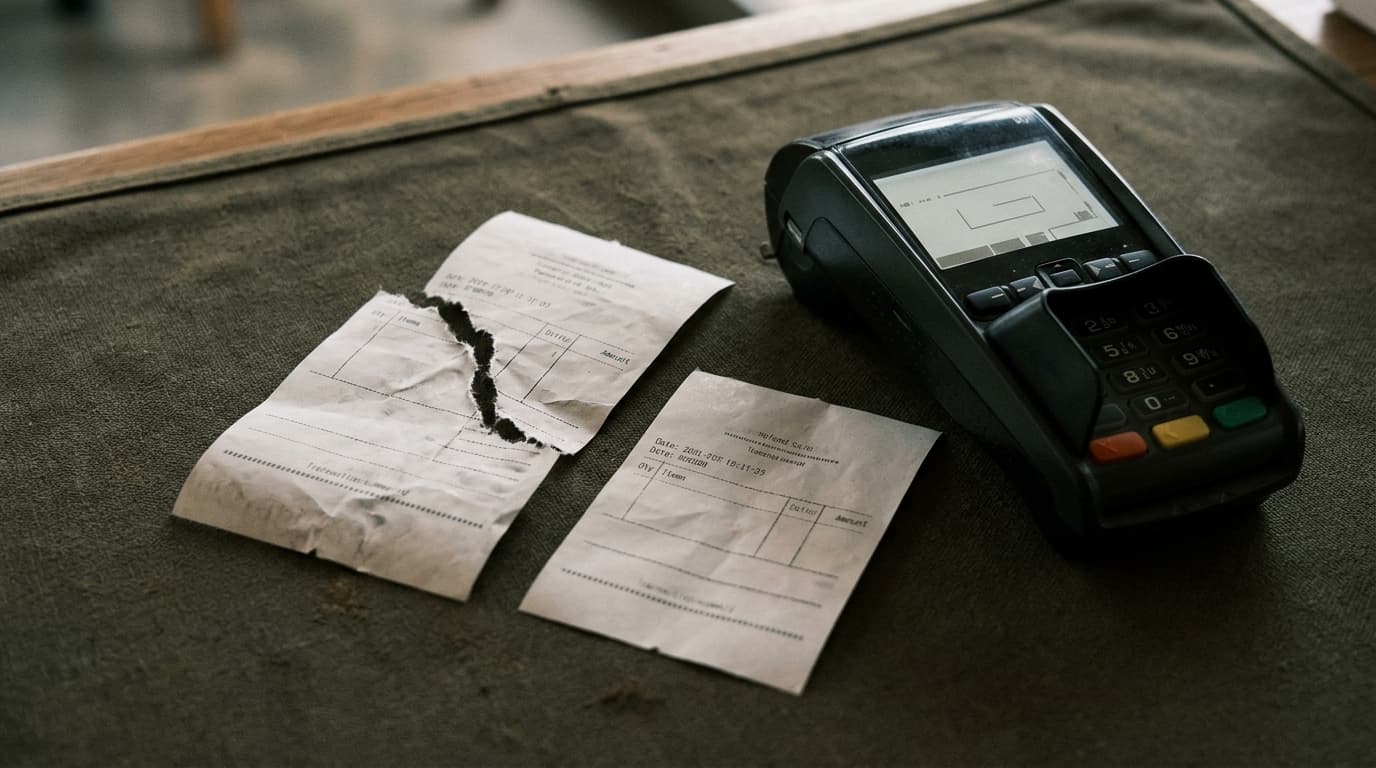
Three words, three mechanisms. A refund comes from the merchant. A chargeback comes from your card issuer, which claims the money from the merchant's bank. A cancellation exists only while the sum has not been debited. Mixing them up costs weeks, and sometimes the 3-month window that makes a chargeback possible.
What is the difference between a chargeback, a refund and a cancellation?
Each has its own actor, its own moment and its own trace on the statement. The table below separates them.
| Word | Who acts | Effect on the statement | Deadline to remember | Guaranteed? |
|---|---|---|---|---|
| Cancellation | The merchant alone | An authorisation is lifted, no debit ever happened | Before the debit. Without cancellation, expiry after 7 days (31 days at Visa for a hotel or rental) | No |
| Refund | The merchant | A new credit line appears, the original debit stays visible | 14 days after withdrawing from a distance purchase | Yes in that case, no elsewhere |
| Chargeback | Your issuer, at your request | The merchant's bank sends the sum back through the network | 3 months maximum after the transaction | No |
The figure to remember: 3 months. It is the chargeback window, and it keeps running while the merchant promises you a refund.
What exactly is a chargeback?
It is a network procedure, triggered by your issuer. Visa Belgium describes it as "an attempt to get your money back" when the goods or services delivered do not match what was bought, including when the merchant has gone bankrupt. The bank that issued your card tries to obtain the refund from the merchant's bank.
The same text adds that a chargeback "gives you no legal entitlement to any refund". It is a contractual service, not a right.
Visa lists four situations: goods or services not received, damaged or counterfeit items, a wrong amount or a double charge, and billing that continues after a subscription was cancelled. The European Consumer Centre Belgium adds the lost parcel and the bankrupt seller, and sets the deadline at 3 months maximum. It also asks you to try first to settle the problem with the merchant.
In the files I used to handle, most refusals came down to that last point. No written trace of an amicable attempt, no case.
Is a merchant refund a chargeback?
No, and the difference is practical before it is legal. The refund goes through the merchant, who sends the money back to the card as a credit transaction. Your statement then shows two lines: the original debit, then the credit.
For a distance purchase, Belgian law gives 14 days to withdraw (article VI.47 of Book VI of the Code of Economic Law). The seller then has 14 days to refund you from the moment you state your wish to withdraw, according to Droits Quotidiens. If it refuses, a complaint can be filed on ConsumerConnect, the FPS Economy platform, or with a mediation service.
A chargeback does not need that agreement. That is also why merchants prefer to refund: a chargeback can weigh on their revenue and reputation.
Can you cancel a card payment?
You cannot. When you validate a payment, the order becomes irrevocable for the cardholder: that is the principle of article 80 of Directive (EU) 2015/2366, known as PSD2. There is no "cancel" button on the customer side.
The merchant acts according to the stage. Before the debit, the sum is only an authorisation, a hold on your available balance. Adyen, which publishes network rules for issuers, is categorical: only the merchant processing the transaction can cancel an authorisation, and the cardholder cannot. Without cancellation, it expires by itself.
| Network | Type of authorisation | Expires after |
|---|---|---|
| Visa | Hotel, car rental, cruise | 31 days |
| Visa | Other merchants | 7 days |
| Mastercard | Pre-authorisation | 30 days, extendable |
| Mastercard | Final or default authorisation | 7 days |
Source: Adyen documentation read on 27 October 2026. A capture remains possible after expiry: the freed sum can still be debited.
The hotel case is detailed in the article on hotel card holds.
Which situation calls for which mechanism?
The right word depends on the failure. The table below sorts the cases I saw most often.
| Situation | First move | If the merchant does not budge |
|---|---|---|
| Payment pending, order not yet shipped | Ask the merchant to cancel the authorisation | Wait for the 7-day expiry |
| Parcel never received | Write to the merchant, keep the trace | Chargeback, within 3 months |
| Online purchase regretted, within 14 days | Withdraw in writing | ConsumerConnect complaint, no chargeback |
| Same purchase debited twice | Ask for the extra line to be refunded | Chargeback for double charge |
| Subscription billed after cancellation | Send proof of cancellation | Chargeback, see the article on the double charge |
| Debit you never made | Block the card, then notify the issuer | Legal refund, 13 months (see below) |
The last line is neither a refund nor a chargeback. It is an unauthorised transaction. The European Consumer Centre indicates 13 months to dispute it with the bank, which must then refund the amount immediately, plus interest. The detail is in the article on the hacked card.

What does a dispute cost while it lasts?
Filing a chargeback costs nothing at the Belgian issuers I was able to check. The disputed debit, however, stays in your balance until it is credited back, and if you carry part of the statement, it can bear interest at the contract rate.
A worked example on the Beobank Visa Classic: annual fee €5, APR 14.49 %, variable borrowing rate 13.98 %, rate read on the official page on 27 October 2026. On €240 in dispute and carried over, interest is about €0.92 per ten days, or €2.76 a month. The rates are those on the page, "in force on 09/05/2025" according to Beobank. My own calculation, simple interest, as an order of magnitude.
Another figure the brochure does not highlight: a €100 ATM withdrawal costs €5 at Beobank (2.50 % of the amount, minimum €5, maximum €15, general conditions read on 24 October 2026). A withdrawal cannot be disputed like a purchase: there is no merchant to claim from.
Over twelve months, that makes €60.00 of withdrawals at €5, before the annual fee. Not enough to build a case, but enough to read the line before signing. One question remains that only your contract settles: is the disputed amount excluded from the interest calculation during the investigation? I cannot deduce it for you.
Points to check in your contract before opening a dispute:
- the deadline for filing a dispute, in days or months;
- what happens to interest on a disputed amount;
- the documents required, and the channel (form, app, letter);
- the response time the issuer announces.
What if the chargeback is refused?
A written complaint to the issuer's complaints department, with the date of your first contact with the merchant and the documents already supplied. It is a prerequisite: Ombudsfin, the Belgian financial-sector ombudsman, examines the case only after that step. Its intervention is free.
For the step-by-step procedure at a specific issuer, the article on disputing a transaction at Beobank follows its form line by line. Deadlines are detailed in the article on the time limit to dispute a card payment, and the general procedure in the one on chargebacks in Belgium.
This article gives landmarks, not advice on your situation. If repayment becomes difficult, an accredited debt mediation service or your commune's CPAS (the public social welfare centre) can help free of charge. To compare cards on their numbers, the ranking of Belgian credit cards, the comparison tool and the selection guide start from the same surveyed rates.
Sources, read on 27 October 2026. Definition of chargeback and covered cases: Visa Belgium. 3-month deadline, contacting the seller first, 13 months for an unauthorised transaction: European Consumer Centre Belgium. Irrevocability of the payment order, article 80: Directive (EU) 2015/2366. 14-day right of withdrawal, article VI.47: Code of Economic Law (2014 commentary, to check against the consolidated text). 14-day refund deadline and ConsumerConnect complaint: Droits Quotidiens. Authorisation expiry and cancellation reserved to the merchant: Adyen, Authorisation holds. Recourse: Ombudsfin. Fee, APR and borrowing rate of the Visa Classic read on 27 October 2026 on the Beobank official page. Withdrawal fees: Beobank general conditions, undated document. The interest calculations on this page are my own and date from 27 October 2026. No link in this article is paid.
Comparator
Compare cartes de crédit side by side.
Compare now →
Frequently asked questions

Delphine a passé sept ans au service litiges et rétrofacturation d’un émetteur de cartes belge, à Liège, entre 2015 et 2022 : le bureau où atterrissent les contestations de porteurs, les retraits facturés deux fois et les cautions d’hôtel qui restent bloquées trois semaines. Elle a donc lu, ligne par ligne, plusieurs milliers de relevés de cartes belges, et elle sait où se logent les montants que personne ne regarde avant de signer. Depuis 2023 elle relève chaque trimestre les tarifs publiés des émetteurs belges et tient le tableau de coûts qui sert de base à ce site. Ce qui l’agace : les brochures qui annoncent une carte à 0 € sans mentionner que le premier retrait au distributeur coûte 5 € fixes plus 1,8 % de commission, et que les intérêts courent dès le jour du retrait.