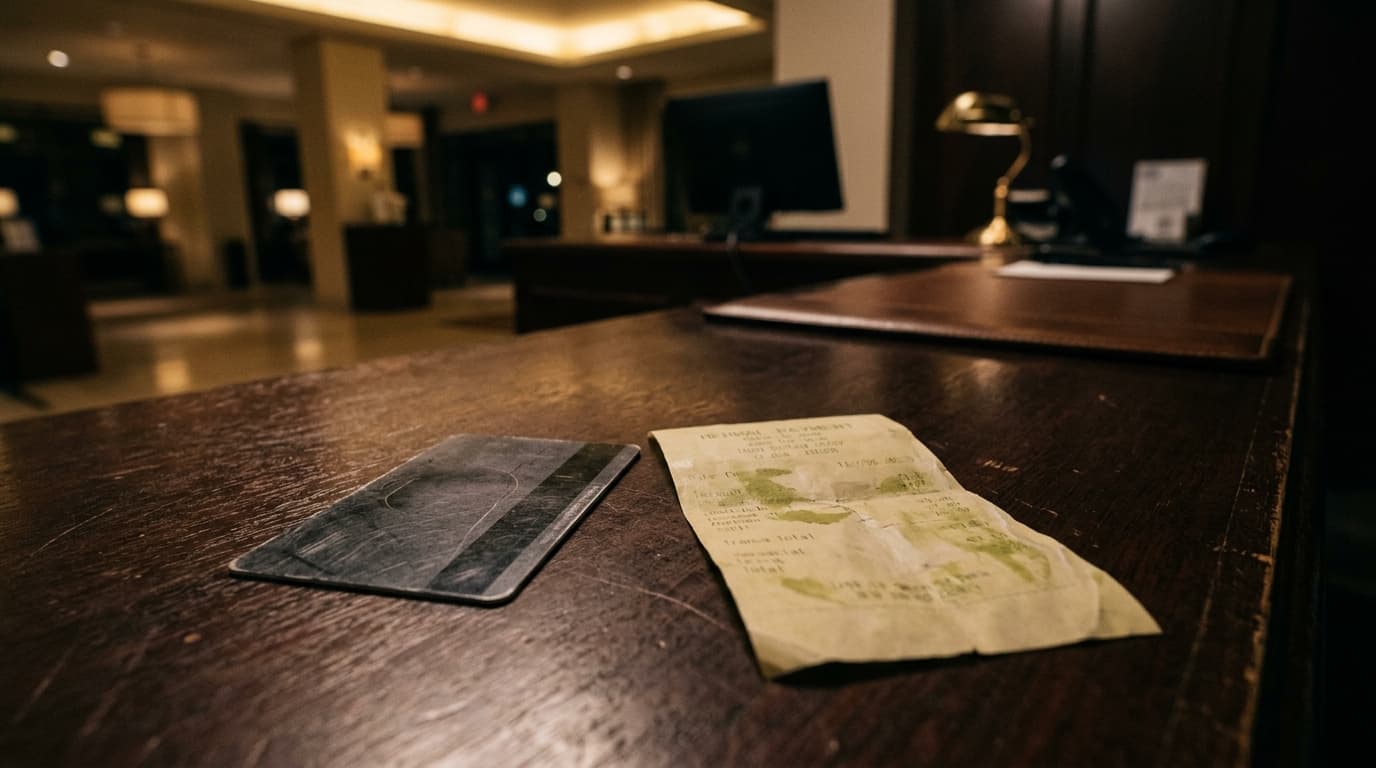
A hotel card hold is not a payment. It is an authorisation: the hotel reserves an amount on your card at check-in, which lowers your available limit, and takes nothing before the final bill. The hold can last up to 31 days on Visa and 30 days on Mastercard. At check-out, you can ask for it to be cancelled.
Is a hotel card hold a charge?
No. The French word for it, empreinte (imprint), dates from the days when reception slid the card into a device that pressed its embossed numbers onto a carbon slip. Today it is an electronic authorisation request, sent to your issuer by the hotel's bank.
The issuer approves, and the amount leaves your available limit. It does not leave your account. In your app it shows as "pending" or "reserved", never on the monthly statement as long as the hotel has not turned it into a charge.
The legal frame is European. Article 75 of Directive (EU) 2015/2366, known as PSD2, only allows funds to be blocked if you agreed to the exact amount, and requires them to be released without undue delay once the final amount is known. The full mechanism, authorisation then clearing then charge, is described in the article on how a credit card works.
How much can a hotel block on your card?
The amount it expects you to spend during the stay, taxes included. No more, in theory.
The best-practice guide Visa addresses to hotels says so in black and white: the estimated authorisation covers the expected cost of the stay and must not include a provision for damage. A hotel that blocks €1,000 for two nights at €140 is outside that rule. Take a worked example: two nights at €140, plus €50 a night for extras, make an authorisation of €380. That is the figure you should be given at reception.
The same guide covers the other direction. If the final bill exceeds the authorised sum by more than 15%, the hotel has to request an additional authorisation. Your available limit can therefore drop a second time during the stay, without the card being used again.
How long does the deposit stay blocked?
Until the hotel cancels it, or until the expiry set by the network. The second date is the later one, and it is the one that applies when the hotel forgets to cancel.
| Network | Type of authorisation | Expires after |
|---|---|---|
| Visa | Hotel, car rental, cruise | 31 days |
| Visa | Other merchants | 7 days |
| Mastercard | Pre-authorisation, all merchants | 30 days, extendable by the merchant |
| Mastercard | Final or default authorisation | 7 days |
Durations published by the payment provider Adyen in its issuer documentation, consulted on 11 October 2026.
A well-run hotel does not wait for expiry. The Visa guide asks hotels to cancel the unused part within 24 hours of check-out (US edition of 2016, the only one published). In practice your available limit then comes back within a few working days, the time it takes the issuer to process the cancellation.
One point surprises almost everyone. An expired authorisation does not stop the hotel from submitting the bill later. The amount that came back to your available limit can therefore still be charged afterwards, with no new authorisation.
Why does the same stay appear twice on the statement?
Because two lines coexist for a few days: the check-in authorisation, still "pending", and the final bill, already charged. It is not a double payment. It is an authorisation the hotel did not cancel.
In the files I handled, it was the most frequent hotel complaint, well ahead of fraud. The cardholder would call, convinced they had paid twice. I had to explain that I could not lift the hold myself. Cancelling an authorisation is a request that only the merchant sends: the issuer sees it, chases it, but does not erase it.
Things change if both lines become charges. That is a real double charge, and it can be disputed. In a file of this kind, the first thing the issuer looks at is the hotel invoice: one stay, one amount, two charges.

Six steps at reception, at check-in then at check-out
- Ask for the exact amount of the authorisation before handing over the card. Not "a deposit", a figure.
- Check your available limit in the app straight afterwards. An additional authorisation may follow.
- Keep the booking confirmation with the cancellation policy. It decides any no-show charge.
- At check-out, ask for the detailed final invoice, extras included, and pay it with the same card.
- Ask for the check-in authorisation to be cancelled, out loud, and write down the person's name and the time.
- Watch your statement for eight weeks. A minibar or extra charge can arrive later.
If you settle the final bill with another card, or in cash, the fifth step becomes essential. The hotel then has no bill to attach to the check-in authorisation, and it can run until it expires.
Can a hotel charge no-show fees?
Yes, when the booking was guaranteed by the card and the cancellation policy was disclosed to you. On Visa, the guaranteed reservations guide limits a no-show to one night in principle.
Belgian law gives you no way out. Article VI.53, 12° of the Code of Economic Law excludes accommodation booked for a specific date from the fourteen-day right of withdrawal. Only the cancellation policy counts.
If you cancelled in time and the night is charged anyway, the file is won on a single document: the cancellation number or email. The networks provide a dispute reason for a cancelled service, with a time limit specific to each network. Your card contract may set a shorter one. Write to the issuer within the following weeks, not months.
What should you do if the deposit does not come back or an amount is added?
Start with the hotel, finish with the issuer. The two situations do not rest on the same basis.
An authorisation still showing after check-out is not a charge: there is nothing to charge back. Ask the hotel in writing to cancel it, then tell the issuer, attaching the final invoice. After 31 days on a Visa, or 30 on a Mastercard, the hold should have disappeared on its own.
An amount added after check-out is a charge. Articles VII.37 and VII.38 of the Code of Economic Law give you eight weeks from the debit to ask for a refund, when the authorisation given at check-in did not state that amount. The procedure is set out in the article on the card hold for car rental, which applies as it stands to hotels. For a double charge or a disputed no-show, see the article on chargeback in Belgium.
Documents to gather before writing:
- the booking confirmation, with the cancellation policy;
- the hotel's detailed final invoice;
- a screenshot of the line still reserved or of the disputed charge;
- the cancellation number, if you cancelled.
If the issuer refuses, go first through its complaints department, in writing. Ombudsfin, the Belgian financial-sector ombudsman, only examines the file after that step. The procedure is free.
A deposit charged then carried over costs the contract's TAEG
An authorisation costs no interest. A charge does. When the hotel bill lands on a card backed by a credit line and you do not pay the whole statement, the amount moves to the contract's rate.
| Card | Annual fee | TAEG | Borrowing rate | Tariff read on |
|---|---|---|---|---|
| Beobank, Visa Classic | €5 | 14.49% | 13.98% variable, on €2,150, rate as at 09/05/2025 | 11/10/2026 |
| KBC, credit card with Flex Budget | €0 (assumption in the TAEG published by KBC) | 9.35% | 8.97% variable | 11/10/2026 |
On a €380 bill carried over for one month, that makes about €4.17 of interest at Beobank and €2.73 at KBC (my own calculation, actuarial rate brought down to a month). Not much. The trouble starts when the minimum instalment becomes the only amount paid: at Beobank it is 1/18 of the amount used, with a €25 minimum. Cards are compared on these figures in the ranking of Belgian credit cards, the comparison tool and the choose your card page. The difference between a debit card and a credit card when facing a deposit is covered in this article.
This article gives reference points, not advice on your situation.
Sources, consulted on 11 October 2026. Blocking of funds and consent to the exact amount: article 75 of Directive (EU) 2015/2366. Exclusion of the right of withdrawal for accommodation on a specific date, article VI.53, 12°, and refund of a payee-initiated transaction, articles VII.37 and VII.38: Belgian Code of Economic Law. Estimated authorisations, additional authorisations above 15% and cancellation within 24 hours: Visa, authorisation best practices for lodging and rental (2016). Expiry periods by network and cancellation reserved to the merchant: Adyen, Authorisation holds. No-show limited to one night: Visa guaranteed reservations guide (2015). Recourse: Ombudsfin. Fee, TAEG, borrowing rate and minimum instalment of the Visa Classic read on 11 October 2026 on the official Beobank page. Borrowing rate, TAEG and assumptions of the KBC credit card with Flex Budget read on 11 October 2026 on the official KBC page. No link in this article is paid.
Comparator
Compare cartes de crédit side by side.
Compare now →
Frequently asked questions

Delphine a passé sept ans au service litiges et rétrofacturation d’un émetteur de cartes belge, à Liège, entre 2015 et 2022 : le bureau où atterrissent les contestations de porteurs, les retraits facturés deux fois et les cautions d’hôtel qui restent bloquées trois semaines. Elle a donc lu, ligne par ligne, plusieurs milliers de relevés de cartes belges, et elle sait où se logent les montants que personne ne regarde avant de signer. Depuis 2023 elle relève chaque trimestre les tarifs publiés des émetteurs belges et tient le tableau de coûts qui sert de base à ce site. Ce qui l’agace : les brochures qui annoncent une carte à 0 € sans mentionner que le premier retrait au distributeur coûte 5 € fixes plus 1,8 % de commission, et que les intérêts courent dès le jour du retrait.