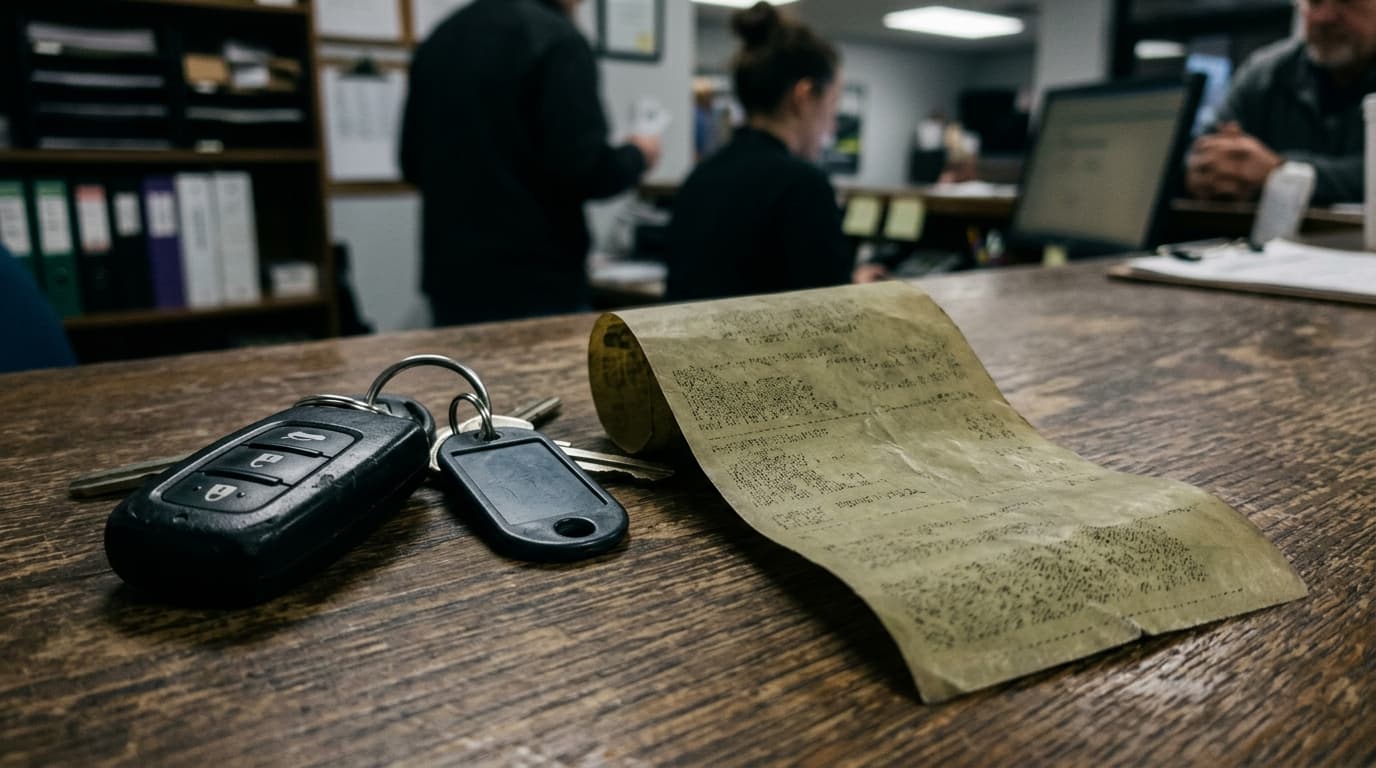
How much does a rental company actually hold on the card?
Between €500 and €1,500 for a standard car in Belgium. The sum is not taken from your current account: it is reserved on the card's credit line, and it eats into your available limit for as long as the rental file stays open.
The amount depends on the vehicle category and on the excess written into the contract. A city car for three days at Brussels Airport sits around €500. An estate car or a van often passes €1,500. Some rental companies size the reservation on the damage excess plus one full tank of fuel.
The figure worth keeping: the card does not decide, the rental company does. Two people presenting the same Visa at the same counter can see two different amounts blocked, depending on the vehicle they are given.
In the files I handled, the most common summer complaint was not an abusive charge. It was a card declined at the end of a trip, because €1,200 of deposit was still sitting on a €2,500 credit line.
Is a debit card enough for the deposit?
No, in the large majority of cases, and the refusal is not arbitrary.
A rental company is not checking that you have money. It is looking for a credit line on which a sum can be reserved for several weeks without being taken. A debit card is tied to an account balance: reserving on it would freeze your real money, which the card schemes do not allow in the same way. Bancontact, the Belgian domestic debit scheme, has no such mechanism at all.
The point that catches travellers out concerns the neobanks. Revolut, N26 and bunq cards issued in Belgium are debit cards, whatever the Visa or Mastercard logo printed on them says. They meet the same refusal as a Bancontact card, and the distinction is set out in the article on the difference between a debit card and a credit card.
A few branches do accept a debit card, almost always in exchange for something: a higher excess, a compulsory damage waiver, a mileage cap, or proof of return travel. That trade-off is rarely priced on the booking site. It is priced at the counter, once the rental is already paid for.
Five things to do at the counter before handing over the card
An issuer looks at one thing first when a deposit file lands on the desk: what you agreed to, and for how much. That point decides the outcome, and it is settled in thirty seconds at the counter.
- Ask for the exact amount that will be blocked. Not the excess, not the theoretical deposit in the contract: the sum actually reserved on the card. Article 75 of Directive (EU) 2015/2366, the second Payment Services Directive, makes the block conditional on your consent to that precise amount.
- Check your available limit before you agree. A €1,500 deposit on a €2,000 credit line leaves you €500 for the whole trip.
- Photograph the rental agreement, including the page with the amounts, before signing it.
- Photograph the vehicle at pick-up, all four corners, the wheels and the fuel level, with the phone's timestamp on.
- Insist on a dated and signed return document, even when the branch is closed and you drop the keys in a box. Without it, the end date of the contract is whatever the rental company says it is.
None of this is precautionary housekeeping. These are exactly the five items an issuer will ask you for if you dispute a charge, and a missing fifth item is enough to sink an otherwise sound file.

Seven to fourteen days to release, thirty at the outside
The reservation does not lift when you hand the keys back. It falls when the rental company closes the file and sends the final amount, or when the period set by the scheme and the issuer runs out.
| Situation | Amount reserved, order of magnitude | Usual release |
|---|---|---|
| Standard car, Belgian branch | €500 to €1,500 | 7 to 14 days after return |
| Van or larger segment | €1,500 to €3,000 | 7 to 21 days |
| Rental abroad, outside the euro area | converted amount, plus currency conversion fee | up to 30 days |
| Hotel, stay deposit | €100 to €500 | 3 to 10 days after check-out |
| Self-service fuel pump | €100 to €150 | a few hours to 3 days |
Thirty days is the ceiling, not the norm. Past that point the reservation has expired at the issuer and the available limit has to come back, whether or not the rental company has closed its file.
How do you chase a deposit that stays blocked?
Through the issuer, not the rental company, and in that order.
Call the branch first to get the date the file was closed. If that date has passed and the reservation is still running, the block is no longer justified: the real amount has been sent, so the excess must be released without undue delay. That is the exact wording of the directive, and it is the wording to use.
Then write to the issuer's disputes department. Three items are enough: the dated return document, a screenshot of the reservation still showing in the app, and the amount actually invoiced. A file arriving with those three is settled in a few days. A file arriving without the return date goes back out as a request for information, and you lose a fortnight.
Do not file a chargeback at this stage. A reserved amount is not a debited amount: there is nothing to charge back, and a badly qualified request is rejected on form before anyone looks at the substance.
Can a charge added after the return be disputed?
Yes, and this is where Belgian law hands you a tool almost nobody uses.
The pattern is familiar. The car goes back, the return check flags nothing, and three weeks later a €180 charge shows up on the statement, labelled "fuel" or "cleaning". The authorisation you gave at the counter covered a deposit, not that amount.
Articles VII.37 and VII.38 of the Code de droit économique, the Belgian Code of Economic Law whose Book VII governs payment services and consumer credit, deal with exactly this case. Where a transaction is initiated by the payee, where the authorisation you gave did not state the exact amount, and where that amount exceeds what you could reasonably have expected given your usual spending and the circumstances, you are entitled to a full refund. The window to ask is eight weeks from the date of the debit. The issuer then has ten business days to refund the whole amount or set out its reasons for refusing, in writing.
Two details that English-language pages on card deposits never carry, because this regime is Belgian. The refund covers the total amount of the transaction, not the difference with what you were expecting. And the refusal has to be reasoned: an answer that simply points at the rental company's terms and conditions does not meet article VII.38.
Waiting is not free either. If those €180 stay on the statement and you carry the balance over, they are charged at the APR of your contract. Rates checked with the issuers on 3 September 2026: the Beobank Visa Classic carries a €5 annual fee and an APR of 14.49% on an open-ended credit facility of €2,150, rates in force since 9 May 2025; the Argenta Mastercard Green carries a €24 annual fee, that is €2 a month, and an APR of 9.50%. The ranking of Belgian credit cards lists those three figures card by card, and the comparison tool puts them side by side.
What if the issuer refuses to refund?
A refusal can be challenged, free of charge.
Go through the issuer's complaints department first, in writing: without that step the file is not admissible any further. Then bring it to Ombudsfin, the Belgian ombudsman service for financial services. The procedure is free, entirely written, and its handling time is 90 calendar days in principle. In 2024 the real average was 56.1 calendar days.
Sources. Blocking of funds on a transaction whose amount is not known in advance: article 75 of Directive (EU) 2015/2366 of 25 November 2015. Refund of a transaction initiated by the payee, eight-week window and ten-business-day reply: articles VII.37 and VII.38 of the Code de droit économique, Book VII. Mediation, admissibility conditions and time limits: Ombudsfin, procedure, 2024 handling figures. Consumer credit framework and maximum APRs: FPS Economy. Annual fees and APRs checked on 3 September 2026 on the public pricing pages of Beobank and Argenta. No link in this article is paid for.
Comparator
Compare cartes de crédit side by side.
Compare now →
Frequently asked questions

Delphine a passé sept ans au service litiges et rétrofacturation d’un émetteur de cartes belge, à Liège, entre 2015 et 2022 : le bureau où atterrissent les contestations de porteurs, les retraits facturés deux fois et les cautions d’hôtel qui restent bloquées trois semaines. Elle a donc lu, ligne par ligne, plusieurs milliers de relevés de cartes belges, et elle sait où se logent les montants que personne ne regarde avant de signer. Depuis 2023 elle relève chaque trimestre les tarifs publiés des émetteurs belges et tient le tableau de coûts qui sert de base à ce site. Ce qui l’agace : les brochures qui annoncent une carte à 0 € sans mentionner que le premier retrait au distributeur coûte 5 € fixes plus 1,8 % de commission, et que les intérêts courent dès le jour du retrait.