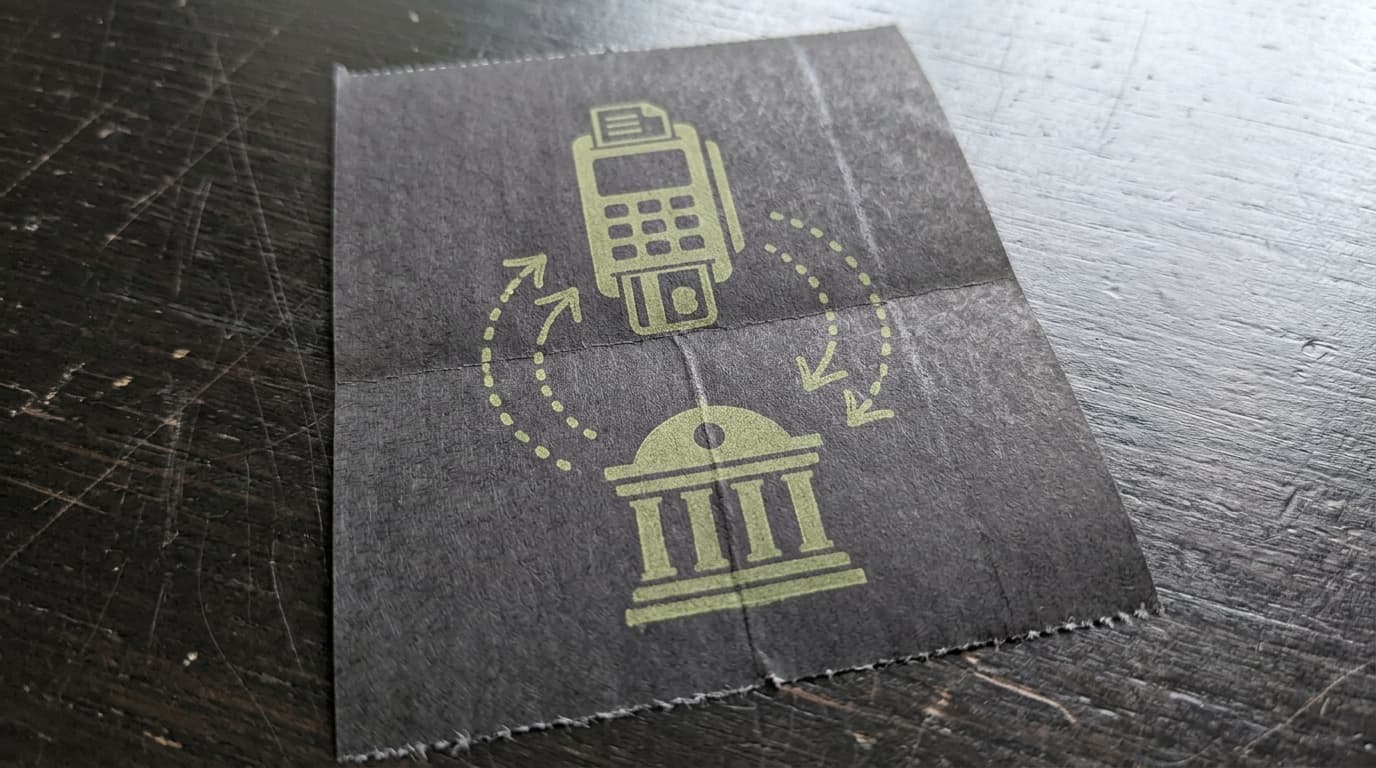
A Visa card is a contract with your bank, running on rails that belong to Visa. The bank lends you the money and sets your fees. Visa carries the payment from one bank to the other and writes the rules both have to follow. It does not know you, and there is nothing you need to ask it.
How does a Visa card work?
It moves a promise of payment between five parties, and Visa is only one of them.
You present the card. The merchant's terminal sends the request to the merchant's bank, the acquirer. The acquirer passes it to the Visa network, which routes it to the bank whose name is on your statement, the issuer. The issuer checks your available balance and answers yes or no. The answer travels back the same way, within seconds. Over the following days, the same circuit is used for clearing, then for settlement between banks.
The logo printed on the card therefore names the circuit, not the lender. On a Belgian credit card, the lender is the issuer, and that is who you signed the credit facility with. That facility (ouverture de crédit) is governed by Book VII of the Belgian Code of Economic Law, the part of Belgian law covering payment services and consumer credit.
The three stages seen from your side, authorisation, clearing and debit, are covered in the article on how a credit card works. This one looks at the other side: who sits along the route, and what each of them decides.
Who does what between you, your bank, Visa and the merchant?
Each party has a role, a contract and a source of income. The table below shows who decides what, and what each one earns.
| Party | Belgian example | What it decides | What it earns |
|---|---|---|---|
| Cardholder | you | when and where to pay | nothing |
| Issuer | Beobank, or whichever bank gave you the card | limit, annual fee, APR, withdrawal charges, exchange margin, outcome of a dispute | annual fee, interest, charges, interchange fee |
| Network | Visa, Mastercard | authorisation rules, deadlines, dispute reasons | network fees paid by banks |
| Acquirer | Worldline and other providers | the merchant's acceptance contract | commission paid by the merchant |
| Merchant | the shop, the hotel, the website | amount requested, any pre-authorisation | the sale price, minus the commission |
In the files I handled, some of the complaints had first gone to Visa. The cardholder had found an address, written a careful letter, and waited. The letter could not land anywhere: Visa has no access to your account, no file in your name, no power to refund you. Those lost weeks then counted against the dispute deadline.
What exactly does the network do during a payment?
Three things: it carries the messages, it organises the exchange of money between banks, and it writes the rulebook that binds all of them.
Carrying messages means authorisation. The network routes the request to the right issuer and brings back the answer. It does not decide whether to approve.
Exchanging money means clearing and settlement. Every day, the network works out what each bank owes the others for the transactions presented, and funds move from the issuer to the acquirer, which then pays the merchant.
The rulebook, finally, is the part that affects you most without you ever reading it. It sets how long a hold on your funds can stay open before the merchant presents the transaction. Documentation published by Mastercard for merchants speaks of a hold of five to eight days in most cases. A final amount should usually be presented within seven days. An estimated amount, the kind a hotel or rental firm uses, can wait thirty to thirty-one days.
At Visa, a bulletin dated 19 October 2023 set new ceilings from 13 April 2024. Thirty days for a hotel, a car rental or a cruise. Ten days for an online payment, and five for other in-store payments. That bulletin was written for US acquirers, and I do not claim every figure applies as such to a Belgian terminal. The order of magnitude is the same.
In a blocked deposit file, the issuer looks first at the estimated-amount indicator sent by the merchant. Without it, the hold should have dropped after a few days. With it, the hold can run for a month, and the statement says nothing about it.
The network rulebook also sets the chargeback reasons and their deadlines. That is what the issuer applies when you dispute an undelivered purchase. The reasons and deadlines are detailed in the article on chargebacks in Belgium.
0.30 € for your bank on a 100 € purchase, 14 € on 100 € carried over
This is the line that explains almost everything else. On every payment, the merchant's bank pays yours a commission: the interchange fee. Regulation (EU) 2015/751 caps it at 0.2 % of the transaction for a consumer debit card and 0.3 % for a consumer credit card. On a 100 € purchase, your bank therefore receives 0.30 € at most.
The same regulation does not, in principle, cover three-party networks where one company both issues the card and signs up the merchant, such as American Express when it issues the card itself. That is one reason some small Belgian shops turn it down, as the article on American Express in Belgium explains.
Now set those 0.30 € against credit. Price surveyed at the issuer on 29 September 2026: the Beobank Visa Classic has an annual fee of 5 €. Its APR is 14.49 %, for a borrowing rate of 13.98 % in force as of 9 May 2025. On 100 € carried over for twelve months, that comes to nearly 14 € of interest. The same purchase then earns the bank more than forty times what interchange pays it.
The network has nothing to do with it, and the next example shows why. Same issuer, same survey on 29 September 2026, different network: the Beobank Extra Mastercard has an annual fee of 20 €. Its APR is identical, 14.49 %, with a borrowing rate of 12.83 %. Two logos, one lender, one advertised APR.

The mechanism that weighs most sits in the minimum monthly payment. At Beobank, it is 1/18th of the credit used as long as the credit line does not exceed 5,000 €. It never drops below 25 €, unless you owe less.
The figure to remember: capped interchange weighs little, interest weighs a lot. The Visa or Mastercard comparison shows that gaps in annual fees and APRs between Belgian cards exist within a single network. They can be read card by card in the ranking of Belgian credit cards and in the comparison tool.
Does a Mastercard work any differently from a Visa?
No, not in principle. Issuer, network, acquirer, merchant: the model is identical, and your contract remains your bank's.
The Belgian difference lies elsewhere. Mastercard Europe SA has its registered office in Waterloo. According to the National Bank of Belgium's 2017 report on payment infrastructures, the NBB oversees two card schemes within the Eurosystem framework: Bancontact and Mastercard Europe. The FPS Economy, the federal economy ministry, supervises the articles of Regulation 2015/751 that protect consumers.
For a cardholder, this oversight creates no complaints desk. The NBB checks the soundness and security of the network. It does not handle individual complaints, and a letter to Waterloo will not speed up a refund any more than a letter to Visa.
Bancontact or Visa Debit: which brand goes through the terminal?
On a Belgian debit card carrying two brands, the one selected at the moment of payment decides which rules apply if the transaction goes wrong.
Most Belgian debit cards are co-badged: Bancontact, the Belgian domestic debit scheme, on one side, and Visa Debit or Debit Mastercard on the other. Article 8 of Regulation 2015/751 lets the merchant program a default brand into the terminal, but the merchant cannot stop you choosing the other one when the device offers it. In Belgium, the terminal most often selects Bancontact.
That choice has a consequence almost nobody knows. Bancontact does not provide chargebacks the way Visa and Mastercard organise them. An undelivered online purchase paid with the Visa Debit brand can enter a network dispute procedure. Paid with the Bancontact brand, it goes down other routes.
I saw it up close: a cardholder was disputing a purchase paid on the Bancontact brand of their card and asking for a "Visa chargeback". The Visa logo was indeed on the card. It was not on the transaction.
Who do you write to when a Visa payment goes wrong?
To the bank that issued the card, always, and in writing. It opens the file, applies the network rulebook and refunds.
Before writing, four checkpoints place your transaction:
- the issuer's name, on the statement or on the back of the card, not the network logo;
- the brand actually used at the terminal, if the card carries two;
- the transaction date, which starts the deadlines running;
- the nature of the problem: a debit you did not authorise, or an authorised purchase that went wrong.
The distinction in the last point matters most. A debit you did not authorise falls under the law: Directive (EU) 2015/2366 and Article VII.41 of the Belgian Code of Economic Law give you thirteen months to report it. An authorised purchase that went wrong falls under the network rulebook and its deadlines, which are much shorter.
If the issuer's answer does not satisfy you, Ombudsfin, the Belgian ombudsman for financial disputes, reviews the file free of charge after a prior written complaint. For a complaint about a payment service, the Directorate-General for Economic Inspection at the FPS Economy can also be contacted. If your card was lost or stolen, the steps are in the article on a lost or stolen card, and the card selection page sorts offers by situation.
Sources, consulted on 29 September 2026. Interchange fee caps and choice of brand on a co-badged card: Articles 3, 4 and 8 of Regulation (EU) 2015/751 of 29 April 2015. Oversight of Bancontact and Mastercard Europe, role of the FPS Economy: National Bank of Belgium, Financial market infrastructures and payment services report, 2017, chapter 3. Authorisation periods: Mastercard Developers, transaction types and Visa Business News AI13522 of 19 October 2023. Holds on funds and unauthorised transactions: Articles 73 and 75 of Directive (EU) 2015/2366; Book VII of the Belgian Code of Economic Law. Admissibility of a complaint: Ombudsfin. Annual fees, APRs, borrowing rates and minimum payment surveyed on 29 September 2026 on the public pages of the Beobank Visa Classic and the Beobank Extra Mastercard. No link in this article is paid.
Comparator
Compare cartes de crédit side by side.
Compare now →
Frequently asked questions

Delphine a passé sept ans au service litiges et rétrofacturation d’un émetteur de cartes belge, à Liège, entre 2015 et 2022 : le bureau où atterrissent les contestations de porteurs, les retraits facturés deux fois et les cautions d’hôtel qui restent bloquées trois semaines. Elle a donc lu, ligne par ligne, plusieurs milliers de relevés de cartes belges, et elle sait où se logent les montants que personne ne regarde avant de signer. Depuis 2023 elle relève chaque trimestre les tarifs publiés des émetteurs belges et tient le tableau de coûts qui sert de base à ce site. Ce qui l’agace : les brochures qui annoncent une carte à 0 € sans mentionner que le premier retrait au distributeur coûte 5 € fixes plus 1,8 % de commission, et que les intérêts courent dès le jour du retrait.