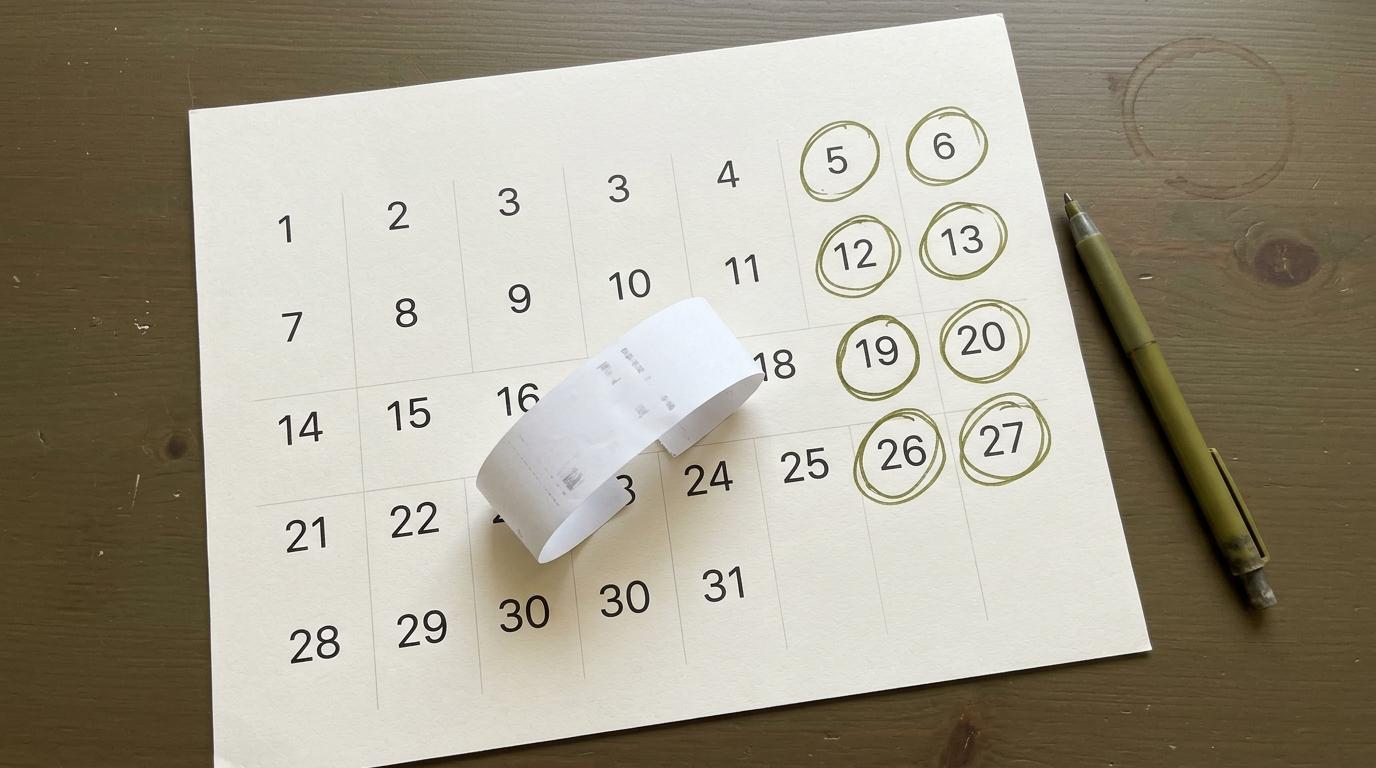
The statement date is the day the issuer closes your bill and works out what you owe. The due date is the day that amount must be paid. Beobank leaves at least 15 days between the two. Mixing them up costs little while you pay in full, and a lot once you carry a balance.
What is the difference between the statement date and the due date?
The first fixes the amount, the second fixes the day of payment. That is all, and it is widely misunderstood.
The statement date, also called the closing date, the spending statement or statement generation, closes a period. Every transaction recorded before that date goes onto the statement. Later ones roll onto the next one.
The due date, or payment deadline, is the day the issuer must have received the money. With a direct debit, the issuer collects it itself that day. Without one, it is up to you to have paid beforehand.
| Contract term | Other names | What it fixes | Where to find it |
|---|---|---|---|
| Statement date | closing date, spending statement, statement generation | the list of transactions and the amount due | at the top of the statement |
| Due date | payment deadline | the day the amount must be paid | on the statement, near the total |
| Debit date | current account debit date | the day the money leaves your account | on your current account statement |
| Zeroing date | legal zeroing period | the date by which the credit line must be brought back to zero | in the contract and on the statement (Buy Way, KBC) |
The figure to remember: two dates a month, and the second one is the one that binds you.
How many days between statement and due date at Beobank and KBC?
At least 15 days at Beobank, about ten days at KBC. The two issuers present it very differently.
Beobank puts it in its credit terms: every month you receive a statement of the previous month's transactions, and it shows a payment deadline set "at least 15 days after the statement generation date". If you pay the full amount by that date, no debit interest is charged.
KBC publishes a calendar instead of a period. On the page for its Flex Budget option, the spending statement goes out around the 20th of the month, the summary is sent on the 1st of the following month, and the amount is debited that day. From the 20th to the 1st, that is about ten to twelve days depending on the month.
| Card | Annual fee | TAEG (APR) | Statement to due date | Price checked on |
|---|---|---|---|---|
| Beobank, Visa Classic | €5 | 14.49% (variable borrowing rate 13.98%) | at least 15 days (credit terms) | 24/10/2026 |
| KBC, credit card with Flex Budget | €0 assumed in KBC's APR example | 9.35% (borrowing rate 8.97%), only if the option is activated | about 10 to 12 days (20th to 1st) | 24/10/2026 |
The prices in this table were checked on the issuers' pages on 24 October 2026. The Beobank period comes from an undated document, consulted on 19 November 2026. The Visa and Mastercard networks set none of these dates: the issuer chooses them, card by card.
Does a purchase made the day before the statement date cost more?
No, if you pay in full. It is simply collected sooner.
Take KBC's calendar. A purchase on 19 September makes the statement of the 20th and is debited on 1 October: 12 days later. A purchase on 21 September misses the 20th and waits until 1 November: 41 days. Both durations are my own calculation, based on the calendar KBC publishes. Neither purchase costs a cent of interest if the statement is paid in full.
Things change as soon as you carry part of the balance. Beobank's terms then provide for daily interest on the outstanding balance and on new card transactions. The statement date no longer protects anything. A €200 purchase that sits for 12 days in a carried balance costs about €0.92 at the 13.98% borrowing rate. My own calculation, in simple interest.
In the files I handled, the complaint nearly always came from a cardholder who had bought on the 20th or 21st believing they would "gain a month". They were right half the time. The other half, they were debited ten days later.

Is the due date the day the money is taken?
Often, not always. It depends on how you pay.
With a direct debit, the issuer collects the amount due on the due date, sometimes a few days earlier. With a manual transfer, the due date is the day the money must have arrived. A transfer sent on the day itself may land too late if it is not an instant payment.
The issuer looks first at the date the payment was received, not the date it was ordered. I have seen cardholders charged for being one day late, holding proof of a transfer sent on time. The proof was not enough: the contract spoke of receipt.
What happens if the due date falls on a weekend or public holiday?
For a direct debit, payment normally goes through on the next business day. The SEPA direct debit rulebook, maintained by the European Payments Council, provides that a due date falling on a non-business day is executed on the next banking business day.
For a manual transfer, I would not count on that. Send it two business days early. Your contract may contain its own rule, and it takes precedence over this general guide.
Which date counts when disputing a charge?
The debit date, not the statement date. For an unauthorised transaction, Article VII.41 of the Belgian Code of Economic Law gives you at most thirteen months from the debit. Book VII of that code is the part that governs consumer credit and payment services in Belgium. The limit is a maximum, not a recommendation.
The right moment to act is between the statement date and the due date. The statement is in front of you, the money has not left yet. A written report at that stage often lets the issuer take the disputed line out of the collection. After the due date, you are recovering money already paid, and the file takes longer. The full procedure is in the article on chargebacks in Belgium.
What do you risk if you miss the due date?
The late fees and late interest set in your contract. Book VII caps these amounts, but the detail depends on the card.
A few points are quick to check:
- the clause in the contract on late interest and reminder fees;
- the due date of the next statement, which often includes the missed amount;
- the effect of a persistent default, which can lead to registration with the Central Individual Credit Register, the national database of consumer credit run by the National Bank of Belgium;
- the zeroing period, if your card is linked to a credit line: Buy Way warns you 8 months and then 2 months before the date, according to its explainer sheet.
If you know the payment will not go through, write to the issuer before the date. A file where the cardholder gave notice is handled differently from a rejection discovered afterwards. The consequences are covered in the article on late payment. If the difficulty persists, an approved debt mediation service or the CPAS, the public social welfare centre of your municipality, will help free of charge. If you disagree with a statement of account, Ombudsfin, the Belgian financial services ombudsman, takes the case after a written complaint to the issuer has gone unresolved. This article gives general guidance, not advice on your situation.
Can you change your card's due date?
Sometimes, on request. I found no provision in Book VII obliging the issuer to accept, nor any Belgian issuer's page promising it.
Ask in writing, give the day you want, and keep the reply. If a debit falls on the old date after your request, that reply is what will count.
Related mechanisms have their own articles: the monthly collection in the one on deferred debit, the number of interest-free days in the one on the grace period, and the floor payment in the one on the minimum payment. To compare cards on their numbers, the ranking of Belgian credit cards, the comparison tool and the choose your card page start from the same checked prices.
Sources, consulted on 19 November 2026 unless stated otherwise. Dispute time limit: Article VII.41 of Book VII of the Code of Economic Law and consumer credit at FPS Economy. Card types: Wikifin, the credit card. SEPA direct debit business days: European Payments Council. Redress: Ombudsfin. Beobank payment deadline, interest rule and monthly minimum: Beobank credit terms, undated document. Visa Classic annual fee, APR and borrowing rate, checked on 24 October 2026: official Beobank page. KBC debit calendar, APR and borrowing rate, checked on 24 October 2026: official KBC Flex Budget page. Zeroing: Buy Way explainer sheet. The duration and interest calculations on this page are my own and date from 19 November 2026. No link in this article is paid.
Comparator
Compare cartes de crédit side by side.
Compare now →
Frequently asked questions

Delphine a passé sept ans au service litiges et rétrofacturation d’un émetteur de cartes belge, à Liège, entre 2015 et 2022 : le bureau où atterrissent les contestations de porteurs, les retraits facturés deux fois et les cautions d’hôtel qui restent bloquées trois semaines. Elle a donc lu, ligne par ligne, plusieurs milliers de relevés de cartes belges, et elle sait où se logent les montants que personne ne regarde avant de signer. Depuis 2023 elle relève chaque trimestre les tarifs publiés des émetteurs belges et tient le tableau de coûts qui sert de base à ce site. Ce qui l’agace : les brochures qui annoncent une carte à 0 € sans mentionner que le premier retrait au distributeur coûte 5 € fixes plus 1,8 % de commission, et que les intérêts courent dès le jour du retrait.