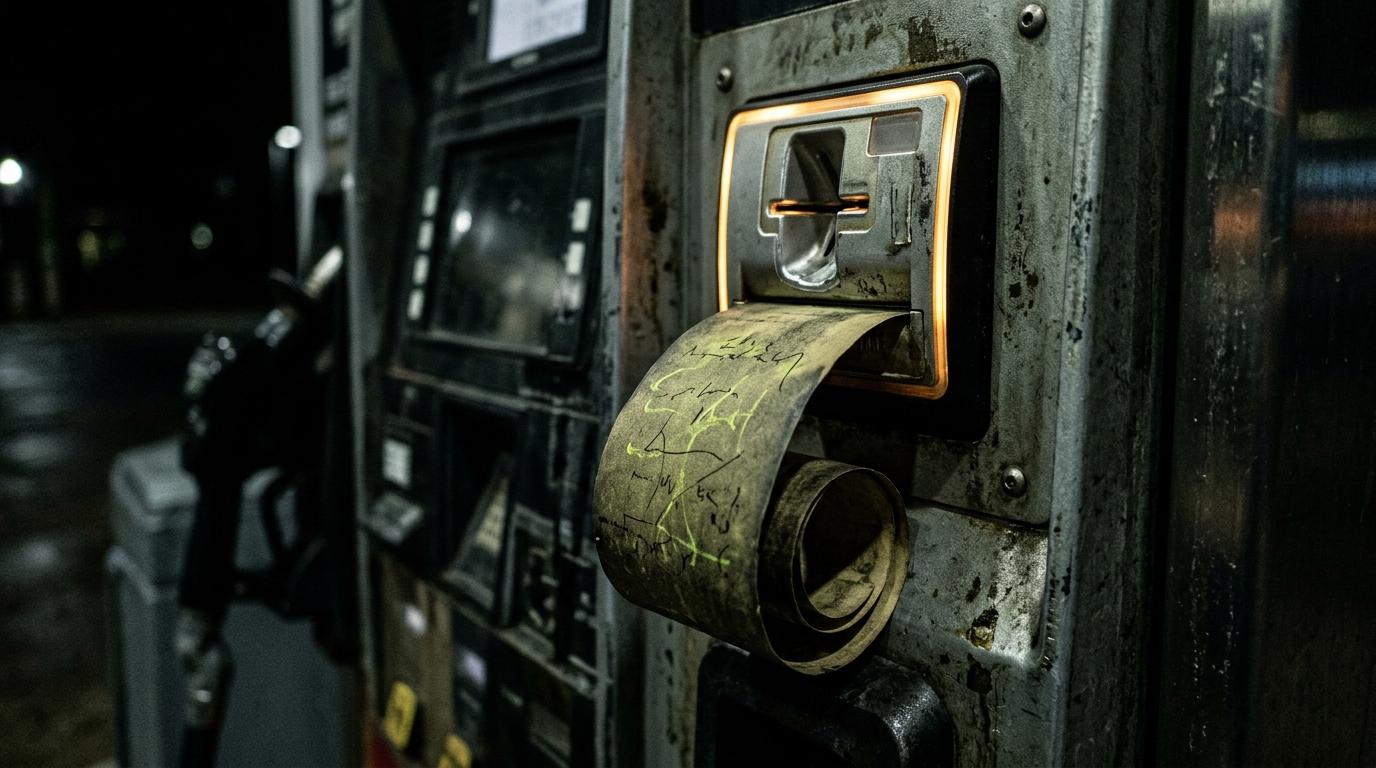
At an unattended pump, your card is not charged when you insert it. The station asks for an authorisation on a ceiling amount, often 100 to 150 euros, then charges only the fuel dispensed. On a recent pump the difference comes back within minutes. On an old machine it can stay reserved for several days.
Why does the pump hold an amount on my card?
Because it serves you before it knows the bill. At a till, the merchant knows the total before handing you the terminal. At a pump with no staff, nobody knows how many litres you will take. So the station asks your issuer to approve a ceiling.
That ceiling is the pre-authorisation. It is set by the station operator, not by your bank. The Belgian fuel-price site Carbu.com put it at 100 to 150 euros in July 2016, the French online bank Fortuneo quotes the same range, and the example it gives is 130 euros. During the fill-up, the pump will not let you go over that amount.
The framework is European. Article 75 of Directive (EU) 2015/2366, known as PSD2, transposed in Belgium into Book VII of the Code of Economic Law (the part of Belgian law that governs payment services and consumer credit), only allows funds to be blocked if you consented to the exact amount. It requires them to be released without undue delay once the actual amount is known. The screen showing "maximum amount 130 euros" before you type your PIN is that consent.
An authorisation is not a charge. It leaves your available credit, not your balance, and does not appear on the monthly statement. The three stages of a payment, authorisation, clearing and settlement, are covered in the article on pending card payments.
How long does the amount stay held?
It all depends on the end-of-fuelling message. When you hang up the nozzle, the pump must send your issuer the amount actually dispensed. That message, and only that message, replaces the 150-euro hold with a 54.30-euro charge.
The best-practice sheet Mastercard sends to fuel stations is precise. In the Europe region, the completion message must go out within 20 minutes of the authorisation, even when the amount dispensed equals the ceiling. In Canada and the United States the window is one hour. The issuer there then has one hour at most to release the difference. For Europe, the sheet only says to release it "as soon as possible".
In practice, four situations come up.
| Situation at the pump | What your issuer sees | When the money returns to your available credit |
|---|---|---|
| Recent pump, completion message sent | The actual amount, a few minutes after fuelling | From a few minutes to a few hours |
| Old machine, actual amount sent later | The hold, then the charge one or two days later | Several days, sometimes longer |
| Nozzle hung up without fuelling | A cancellation or a zero amount | Immediately in principle, otherwise as above |
| No message from the station | The hold alone | When the authorisation expires under network rules |
The last row is the longest. According to the documentation of the payment provider Adyen, an ordinary authorisation expires after 7 days at Visa and at Mastercard, a Mastercard pre-authorisation after 30 days. The French consumer site MoneyVox wrote in September 2021 that on machines that do not work in real time, the sum could stay blocked "for several days, even several weeks".
In the files I handled, pump complaints arrived on Monday mornings. A fill-up on Saturday evening at an unstaffed station, a hold still visible on Monday, and a cardholder convinced they had paid twice. Almost always, the hold dropped off by itself during the day.
Why is my card declined at the pump when the fuel costs less?
Because the pump does not ask for the price of your fill-up. It asks for its ceiling. If your available credit is lower, the issuer says no, even for 40 euros of petrol.
Fortuneo's example says it all: a 50-euro balance, a 130-euro ceiling, and a decline for a fill-up that would have cost 40. On a credit card, what counts is the available credit on the line, not the limit in the contract. A Buy Way Mastercard One with a 1,250-euro limit and 1,180 euros already used leaves only 70 euros: it will go through at the till, not necessarily at the machine.
There is a technical workaround, partial approval. The issuer approves less than requested, and the pump stops at that amount. The Mastercard sheet presents it as required for European stations. Visa, questioned by the British press in May 2018, likewise explained that the pump should stop at the approved amount when the balance was lower. Not every station and not every issuer applies it.
A decline can have other causes. A card that is genuinely blocked, a stop on the card, a wrong PIN or a security check by the issuer are not handled the same way.
Does the held amount cost interest or a commission?
No. An authorisation does not enter the card balance. It earns no interest and carries no commission. Any charges apply to the final amount charged, and to that alone.
This matters outside the eurozone. In Switzerland or the United Kingdom, the station holds a ceiling in local currency, converted for your issuer. The exchange commission only applies to the fuel actually charged. On 80 euros of fuel paid outside the eurozone, that comes to 1.68 euros with a Beobank Visa and 2.00 euros with a Buy Way Mastercard One. In Luxembourg, where many Belgians fill up, there is no currency exchange at all. How the commission works is explained in the article on foreign exchange fees outside the eurozone.
The real cost comes later, if the fill-up enters a balance you do not repay in full.
| Card | Annual fee | APR on the carried balance | 100-euro withdrawal | Non-euro commission | Rate checked with the issuer on |
|---|---|---|---|---|---|
| Beobank Visa | 5.00 euros | 14.49% (credit line of 2,150 euros, rate as of 9 May 2025) | 5.00 euros (2.50%, minimum 5 euros) | 2.10% | 14 November 2026, price list valid from 1 October 2026 |
| Buy Way Mastercard One | 17.50 euros | 14.50% (example for 5,000 euros) | 6.50 euros | 2.50% | 14 November 2026, guide of September 2025 |
A 70-euro fill-up carried over one month costs less than 0.80 euros in interest on either card. That is my calculation, at each card's actuarial borrowing rate. Four fill-ups a month never repaid is another matter: over twelve months, that puts 3,360 euros of fuel into the outstanding balance, at the contract rate. The effect of a minimum payment on that kind of balance is explained in the article on balance, outstanding and available credit.
Pump, hotel, rental car: same mechanism, different duration
The pump is the shortest pre-authorisation. It lives a few minutes when everything works. A hotel deposit can run for up to 31 days at Visa, and a car rental deposit is counted in hundreds of euros. Both cases have their own article: the hotel card hold and the card hold for car rental.
On a debit card, such as those used with Bancontact, Belgium's domestic card scheme, the logic is identical. The difference is whose money is involved: it is your current account that is tied up, not a credit line.
What should I do if the amount is not released?
First wait one working day. Then act in this order:
- note the date, the time, the station's address and the pump number, and keep the receipt if the machine printed one;
- take a screenshot of the pending line in your app, with its amount;
- write to the station operator asking for the authorisation to be cancelled or the actual amount to be sent;
- notify your issuer's complaints department in writing, with the screenshot and the receipt;
- watch the statement: a late charge for the right amount is normal, a charge for the full ceiling is not.
The issuer does not lift an authorisation itself. In a pump file, what the issuer looks at first is the time of the authorisation and whether the completion message exists. Without that message, it waits for the station or for expiry.
If the full ceiling was charged instead of the fuel, that is a charge, and it is disputed as a wrong amount. The procedure and its deadlines are in the article on the time limit to dispute a card payment. If you receive a written refusal, Ombudsfin, the Belgian ombudsman for financial disputes, reviews the complaint free of charge once you have complained to the issuer.
Who pays if someone fills up on my pump left open?
This is the nastiest case, and it is not covered as fraud. Selectra described the scenario in August 2026 based on French cases: a stranger offers cash for a small fill-up paid with your card, or blocks the nozzle sensor so the transaction does not close. The next person fills up to the ceiling.
You typed your PIN. The transaction is therefore authorised, and the protection against unauthorised payments does not apply. What remains is articles VII.37 and VII.38 of the Code of Economic Law: asking for a refund of a transaction whose exact amount was not fixed and exceeds what you could reasonably expect. The deadline is eight weeks from the charge, and the issuer has ten working days to refund or justify its refusal.
The argument is weak when the screen clearly showed the ceiling. In the files I handled, what made the difference was the receipt, the time of the police report and the station's video when the operator agreed to keep it. If your card left your sight, have it blocked through Card Stop on 078 170 170, as for a lost or stolen card.
I have not found a single Belgian operator that publishes the exact amount of its pre-authorisation. Read the pump screen before typing your PIN: that is where the figure is written, and nowhere else.
To compare cards on their three figures, annual fee, APR and the cost of a 100-euro withdrawal, see the ranking of Belgian credit cards, the comparison tool and the choose your card page.
Sources, consulted on 14 November 2026. Blocking of funds on a consented amount and release without undue delay: article 75 of Directive (EU) 2015/2366. Refund of a payee-initiated transaction, articles VII.37 and VII.38: Code of Economic Law, Book VII. Completion message within 20 minutes in Europe, release within one hour in Canada and the United States, partial approval: Mastercard, Best Practices for Automated Fuel Dispenser Processing, undated. Authorisation expiry periods: Adyen, Authorisation holds. Amount of 100 to 150 euros: Carbu.com, 20 July 2016, and Fortuneo online help. Holds of several days on old machines: MoneyVox, 21 September 2021. Pump left open: Selectra, 26 August 2026. Beobank Visa: card page and price list for private customers valid from 1 October 2026. Buy Way Mastercard One: user guide, September 2025. Recourse: Ombudsfin. Exchange commissions and interest on a fill-up: the author's calculation, 14 November 2026. No link in this article is paid for.
Comparator
Compare cartes de crédit side by side.
Compare now →
Frequently asked questions

Delphine a passé sept ans au service litiges et rétrofacturation d’un émetteur de cartes belge, à Liège, entre 2015 et 2022 : le bureau où atterrissent les contestations de porteurs, les retraits facturés deux fois et les cautions d’hôtel qui restent bloquées trois semaines. Elle a donc lu, ligne par ligne, plusieurs milliers de relevés de cartes belges, et elle sait où se logent les montants que personne ne regarde avant de signer. Depuis 2023 elle relève chaque trimestre les tarifs publiés des émetteurs belges et tient le tableau de coûts qui sert de base à ce site. Ce qui l’agace : les brochures qui annoncent une carte à 0 € sans mentionner que le premier retrait au distributeur coûte 5 € fixes plus 1,8 % de commission, et que les intérêts courent dès le jour du retrait.