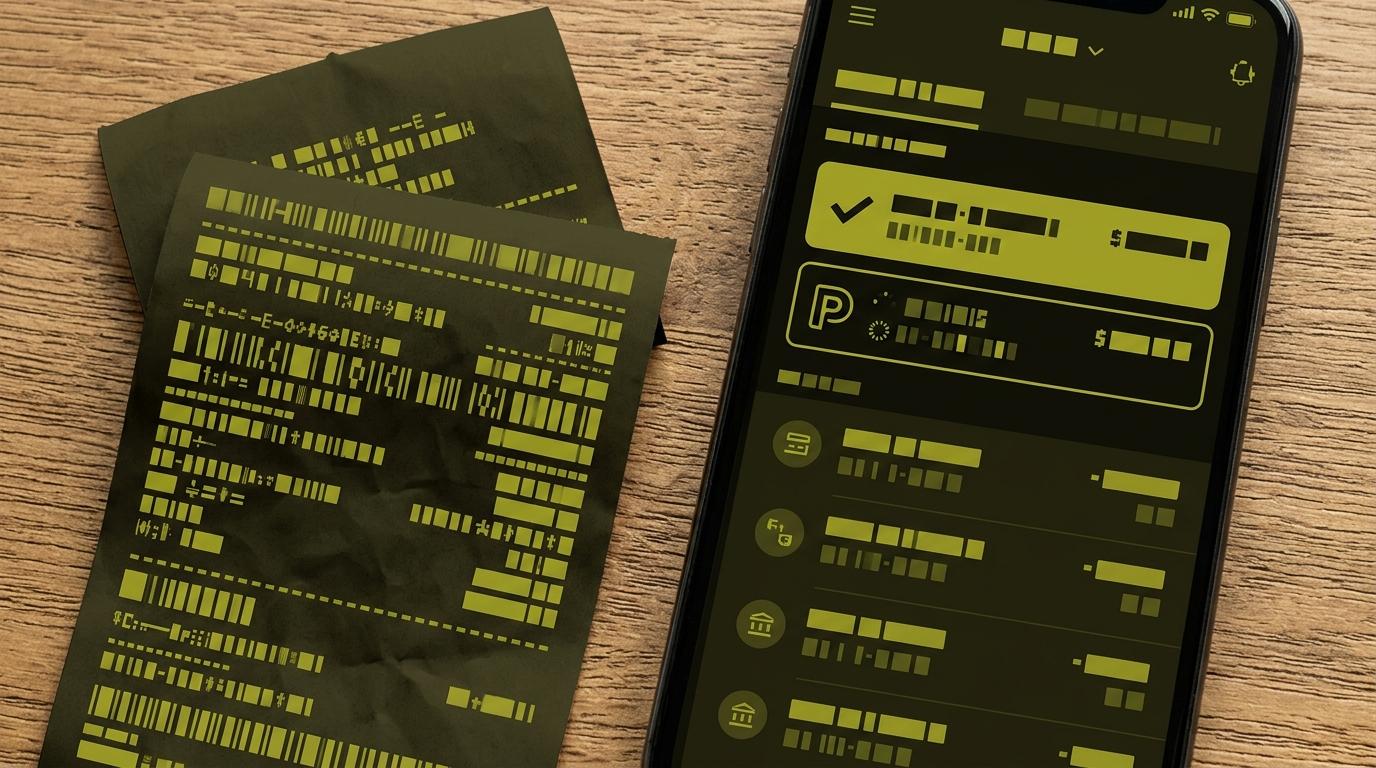
A pending payment is an authorisation, not a charge. The issuer has reserved the sum on your available credit, and the merchant has not yet submitted its bill. For an ordinary purchase this lasts a few working days. For a hotel or a rental car, it can last up to 31 days.
What is the difference between authorisation, clearing and settlement?
They are three separate moments of the same purchase, and your app often shows them under one word. The table separates them. Belgian apps and statements are in French, so the local terms are given in brackets.
| Stage | Who does what | Effect for you | Usual timing |
|---|---|---|---|
| Authorisation (autorisation) | The terminal or website asks your issuer, which answers yes or no | The sum leaves your available credit. No balance moves | A few seconds |
| Clearing (compensation) | The merchant sends its bill to its bank, which passes it through the Visa or Mastercard network to your issuer | The line moves from "pending" to "processed" | In principle by the end of the first working day (PSD2, article 83), often 24 to 72 hours in practice |
| Settlement (débit effectif) | The issuer posts the final amount to your balance | The amount enters your statement, and the APR can start running | Working days following clearing |
The legal framework is European. Article 75 of Directive (EU) 2015/2366, known as PSD2, only allows funds to be blocked if you agreed to the exact amount. Article 83 of the same directive requires your bank to get the payment to the merchant's bank by the end of the first working day at the latest. That is why delays stretch over weekends.
In the files I handled, the confusion almost always came down to the word "charged". The cardholder saw 84.90 euros pending, said "they have already taken my money", and could not find the line on the statement. It was not there: an authorisation never has an accounting existence.
How long does an authorisation stay pending?
It depends on the network and the type of merchant. Expiry is automatic, and the sum then returns to your available credit.
| Network | Case | Authorisation lifespan |
|---|---|---|
| Visa | Ordinary purchase | 7 days |
| Visa | Hotel, car rental, cruise | 31 days |
| Mastercard | Final or default authorisation | 7 days |
| Mastercard | Pre-authorisation | 30 days, extendable by the merchant |
Durations published in the issuer documentation of Adyen, consulted on 9 November 2026. Visa also allows an extension of up to 30 days for certain remote purchases.
One point almost always surprises people. Expiry releases the sum, but it does not extinguish the merchant's right to submit its bill. An amount that went back to your available credit can therefore be charged later, with no new authorisation. The hotel deposit, the textbook case of pre-authorisation, is covered in the article on the hotel card hold.
Why do 150 euros vanish from my available credit at the pump?
Because the terminal does not know, before you fill up, how much you will take. It therefore asks for an authorisation on a plausible sum. Carbu.com wrote in July 2016 that an amount of 100 to 150 euros may be held while you fill up, and that only the amount actually consumed is charged; the rest of the hold is then released. The article adds that cancellation is not always immediate, and quotes the Groupement des Cartes bancaires, which was asking for it to be sped up.
The figure is old, and I have not found it confirmed by a Belgian issuer. Keep the mechanism rather than the amount: a hold larger than your purchase, released with a delay. On a credit line of 1,000 euros, a 62-euro fill-up with a 150-euro hold deprives you of 88 euros of available credit for a few days. That is not a cost. It is an inconvenience, and it shows most when travelling, with tight available credit.
What happens if the amount charged is not the amount authorised?
The charge prevails over the authorisation. The second is only an estimate, the first is the merchant's claim, and the two amounts can legitimately differ: tip, extras, partial fill-up.
Two rules still protect the cardholder. The first is in PSD2, article 80: a payment order can no longer be revoked once received by the bank. You therefore cannot "cancel" a purchase you validated. The second is Belgian. Articles VII.37 and VII.38 of the Code of Economic Law, whose Book VII sets Belgium's payment-services and consumer-credit rules, let you ask for a refund of a payee-initiated transaction when the authorisation did not specify the exact amount and the amount exceeds what you could reasonably expect. The deadline is eight weeks from the charge.
The issuer looks first at the date of the authorisation, the date of clearing, and the invoice. A file that arrives with those three documents is dealt with in one reading.

Does a pending payment cost interest?
No, as long as it has not become a charge. A hold does not enter the balance, so it earns no interest. It simply lowers available credit.
The cost appears at settlement, if you do not pay the whole statement. Here are the three figures of two Belgian cards to measure the stakes on a 380-euro invoice.
| Card | Annual fee | APR on the carried balance | 100-euro withdrawal | Rate checked on |
|---|---|---|---|---|
| Beobank Visa | 5 euros | 14.49% (actuarial borrowing rate 13.98%, credit line of 2,150 euros) | 5 euros (2.50%, minimum 5 euros) | 3 November 2026, price list of 1 August 2026 |
| Buy Way Mastercard One | 17.50 euros | 14.50% (variable borrowing rate 13.75%, credit line of 5,000 euros) | 6.50 euros | 3 November 2026, guide of September 2025 |
Over twelve months, that comes to nearly 53 euros of interest for 380 euros carried and never repaid, at Beobank's actuarial rate (my calculation, an order of magnitude). The useful thing is to know it before the charge, not after. How carrying a balance works is in the article on the balance, outstanding and available credit, and the interest-free period in the one on the grace period.
Credit card or debit card: does the hold weigh the same?
No. On a credit card, it is the usable limit that goes down. On a debit card, such as those used with Bancontact, the sum is held on your current account: it is your real money that is tied up for the length of the authorisation. The difference shows most when the account is tight. The comparison between the two cards is in the article debit card or credit card.
What should I do when a pending payment will not clear?
In order, without skipping steps:
- Note the purchase date, the pending amount and the merchant name as it appears.
- Wait the usual time: seven days for an ordinary purchase, the network's duration for a hotel or a car.
- Write to the merchant to ask for the authorisation to be cancelled. Keep the reply.
- Then write to the issuer's complaints department, with a screenshot of the line and your exchange with the merchant.
- Watch the statement for eight weeks. A late charge is possible.
If a pending line turns into a charge you dispute, the route is the chargeback, and the deadlines are set out in the article on the time limit to dispute a payment. If the issuer's answer is not satisfactory, Ombudsfin, the Belgian ombudsman for financial disputes, is free and opens after your written complaint.
If a prolonged hold strains your budget, an approved debt mediation service or your municipality's CPAS (public social welfare centre) can help, free of charge. This article explains vocabulary; it does not replace a review of your situation. To compare cards on what they cost, the ranking of Belgian credit cards, the comparison tool and the choose your card page all start from the same checked rates.
Sources, consulted on 9 November 2026 unless stated otherwise. Funds blocked on an agreed amount, execution by the first working day, irrevocability: articles 75, 83 and 80 of Directive (EU) 2015/2366. Refund of a payee-initiated transaction, articles VII.37 and VII.38: Code of Economic Law, Book VII. Expiry durations, cancellation reserved to the merchant, bill possible after expiry: Adyen, Authorisation holds. Hold at the pump: Carbu.com, 20 July 2016. Annual fee, APR, borrowing rate and withdrawal of the Beobank Visa: Beobank price list for private customers, valid from 1 August 2026. Mastercard One: Buy Way user guide, September 2025 edition. Recourse: Ombudsfin. Clearing times in days are the author's orders of magnitude, and the interest calculations are her own. No link in this article is paid for.
Comparator
Compare cartes de crédit side by side.
Compare now →
Frequently asked questions

Delphine a passé sept ans au service litiges et rétrofacturation d’un émetteur de cartes belge, à Liège, entre 2015 et 2022 : le bureau où atterrissent les contestations de porteurs, les retraits facturés deux fois et les cautions d’hôtel qui restent bloquées trois semaines. Elle a donc lu, ligne par ligne, plusieurs milliers de relevés de cartes belges, et elle sait où se logent les montants que personne ne regarde avant de signer. Depuis 2023 elle relève chaque trimestre les tarifs publiés des émetteurs belges et tient le tableau de coûts qui sert de base à ce site. Ce qui l’agace : les brochures qui annoncent une carte à 0 € sans mentionner que le premier retrait au distributeur coûte 5 € fixes plus 1,8 % de commission, et que les intérêts courent dès le jour du retrait.