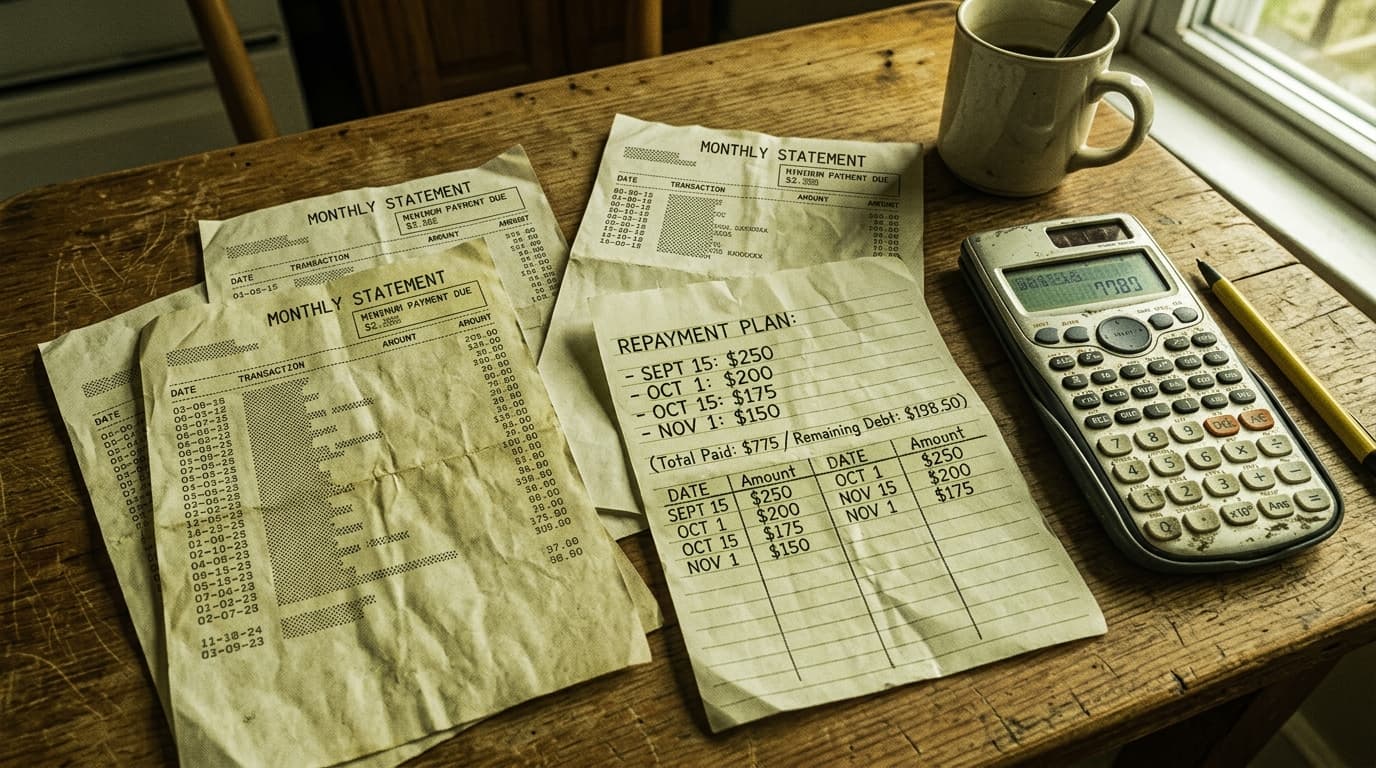
Yes. A credit card debt can go into debt mediation in Belgium just like a loan or an energy bill. At a CPAS (public social welfare centre) or an approved service, it costs you nothing. It does not make the balance disappear: it builds it into a repayment plan that the card issuer has to accept.
Can a credit card debt be included in debt mediation?
Yes, with no special condition. Behind almost every Belgian credit card sits an open-ended credit facility, in other words a consumer credit governed by Book VII of the Code of Economic Law (Livre VII du Code de droit économique, the Belgian consumer credit rules). The Visa or Mastercard logo changes nothing: your contract is with the issuer, not with the network.
The mediator treats that contract like the household's other debts. They ask for the statement of account, check the amounts, then build it into the plan.
The weight of these contracts in Belgian arrears is measured. On 31 December 2025, the Central Individual Credit Register (Centrale des Crédits aux Particuliers, the National Bank's register of every consumer and mortgage credit in Belgium) recorded 367,513 payment defaults. Credit facilities accounted for 43.5 % of them, or around 160,000 contracts, according to the figures published by the National Bank of Belgium. That is the largest category, ahead of instalment loans.
In the files I handled, the credit card was often the last debt anyone mentioned to the mediator. It does not look like a loan: no signature at a branch, no fixed monthly instalment, just a minimum to pay on a statement you eventually stop opening. The holder filed it mentally under everyday spending and left it out of the inventory, so the plan, built without it, collapsed at the very next statement.
How much does a debt mediation service cost?
Nothing, at a CPAS or an approved service.
Services approved by the Regions and Community Commissions, whether a CPAS or a non-profit, do not charge the debtor. Article VII.115 of the Code of Economic Law prohibits debt mediation by anyone who does not fall into one of two categories. The first covers lawyers, ministerial officers and court-appointed agents, acting in their professional capacity. The second covers public institutions and approved private institutions. The first may be paid, the second may not.
A company offering to "negotiate your debts" for a commission, without being a lawyer or an approved service, is therefore carrying out a prohibited activity. It should not be confused with a debt collection agency, which works for the creditor.
CPAS, approved service or collective debt settlement: what is the difference?
Amicable mediation is a voluntary negotiation, with no judge. Collective debt settlement (règlement collectif de dettes) is a court procedure, before the labour court.
Title 3 of Book XIX of the Code of Economic Law, inserted by the law of 3 May 2024 and in force since 10 June 2024, gives amicable mediation a legal framework for the first time. It begins when you sign an agreement with the mediator (article XIX.25, § 1). Collective debt settlement falls under articles 1675/2 and following of the Judicial Code.
| Amicable mediation, CPAS or approved service | Amicable mediation, lawyer, bailiff or notary | Collective debt settlement | |
|---|---|---|---|
| Starting point | Agreement signed with the mediator | Agreement signed with the mediator | Petition to the labour court |
| Cost to you | EUR 0 | Fees | Court-appointed mediator's fees, paid first |
| Card issuer's agreement | Required | Required | Required for an amicable plan, otherwise the judge can impose one |
| Interest on the card balance | Keeps running, unless the creditor agrees | Keeps running, unless the creditor agrees | Suspended from admissibility |
| Attachments | Not suspended, but the bailiff must contact the mediator first | Same | Suspended |
| Length | No legal maximum | No legal maximum | 7 years for an amicable plan, 5 years for a judicial plan, save exceptions |
| Record | Notice in the central file of attachment notices | Notice in the central file of attachment notices | Notice in the Central Individual Credit Register |
Sources: Code of Economic Law, Book XIX; Judicial Code, articles 1675/7 and 1390octies; brochure of the Support Centre for debt mediation services of the Brussels-Capital Region. Recorded on 1 October 2026.
The choice between the two is not made on a web page. It is made with the mediator, who knows your budget, and who can draft the petition if collective debt settlement becomes the only way out.

How does debt mediation work, step by step?
In five stages. The brochure of the Walloon reference centres, reissued by the Brussels-Capital Region's Support Centre for debt mediation services, sets them out in this order.
- The assessment. The mediator meets you and draws up the inventory: income, outgoings, debts. The credit card goes in with its exact balance, not with the minimum on the last statement.
- The agreement and the letter to creditors. Once the agreement is signed, the mediator writes to each creditor to confirm the amount owed and ask for enforcement to be put on hold, usually for three months.
- The notice in the attachment file. Since 1 July 2025, article 1390octies, § 3 of the Judicial Code requires the mediator to have a notice of amicable mediation filed in the central file of attachment notices, at no cost to you. A bailiff who wants to act for the issuer must check that file, then pass the claim to the mediator, who has one month to respond.
- Checking the amounts. The mediator checks whether what is claimed is lawful: interest, penalties, reminder charges.
- The repayment plan. It is put to all creditors at the same time. Once accepted, you pay yourself, and the mediator follows the file and informs creditors of any change.
The mediator never pays on your behalf. In amicable mediation the payments remain yours, and a plan that is not kept usually ends with the creditors being informed.
What happens to the credit card during mediation?
It stops being used. Every new charge on a credit facility adds a debt to a plan that did not provide for it, and that is the most ordinary reason an amicable mediation fails. In a collective debt settlement, article 1675/7 of the Judicial Code goes further and prohibits any act that worsens insolvency.
In the files I saw come through, the line had usually been blocked by the issuer well before the mediator's letter arrived. The holder only found out when a payment was declined at the till.
The balance, meanwhile, keeps generating interest during amicable mediation, unless the issuer agrees to freeze it. Take the basic KBC credit card with the Flex Budget option. Annual fee: EUR 0. Variable borrowing rate: 8.97 %, for an APR of 9.35 %. Rates recorded from the issuer on 1 October 2026.
On a carried balance of EUR 2,000, that comes to EUR 14.95 of interest in the first month. Over twelve months without any repayment, that comes to around EUR 187. KBC also points out that the monthly payment must be at least 5.6 % of the unpaid balance, which is EUR 112 on that EUR 2,000.
After a default, further amounts are added. The general conditions of Beobank credit cards, version of 1 May 2024, provide for a lump-sum indemnity of 10 % on the tranche of capital up to EUR 7,500, and EUR 7.50 per reminder letter. On EUR 2,000 of capital due, the indemnity reaches EUR 200. This is exactly the kind of line the mediator checks before building the plan.
Five documents to bring to the first appointment
- the last three statements for each credit card, showing the balance, the minimum due and the rate applied;
- the credit facility agreement or, failing that, the issuer's general conditions with their version date;
- any formal notice, reminder letter or letter from a collection agency or a bailiff;
- proof of income and the household's fixed outgoings;
- a statement of your credits recorded in the Central Individual Credit Register, which the National Bank issues free of charge.
The card statement is the document I would have asked for first. It gives the date the balance was struck, the rate actually applied and the charges already booked.
Wallonia, Brussels, Flanders: three ways in
The CPAS of your municipality is the simplest door everywhere. In Wallonia, 1718, the Region's free information line, points you to an approved service near you, and the Credit and Debt Observatory (Observatoire du Crédit et de l'Endettement) publishes the list of services. In Brussels, the Region refers you to the CPAS and to the services approved by the Common Community Commission. In Flanders, debt mediation (schuldbemiddeling) goes through approved OCMWs and CAWs.
What if the issuer refuses the plan?
Nothing obliges a creditor to accept an amicable plan. A refusal is not unlawful.
The mediator can then steer you towards collective debt settlement and draft the petition. As soon as the labour court declares the application admissible, interest stops running and attachments are suspended. If no agreement is reached on an amicable plan, the judge can impose a judicial plan.
Ombudsfin, the Belgian ombudsman for financial services, does not impose repayment plans. It handles a specific dispute with the bank, such as contested charges or a debit you do not recognise, and only after a written complaint to the issuer's complaints department. I do not give advice on a situation I do not know: the debt mediator is the person who can.
The mechanics of a carried balance are set out in the article on credit card interest, and closing a settled contract in the one on cancelling a credit card. The ranking of Belgian credit cards gives the annual fee and APR card by card, the comparison tool places them side by side, and the choosing a card page sorts by situation.
Sources. Payment defaults at 31 December 2025: National Bank of Belgium, the ICR in figures, consulted on 1 October 2026. Article VII.115 and Title 3 of Book XIX: Code of Economic Law, consolidated version. Notice of amicable mediation in the central file of attachment notices, article 1390octies, § 3 of the Judicial Code, and the course of a mediation: Support Centre for debt mediation services, consulted on 1 October 2026. Approved services: Credit and Debt Observatory and Brussels-Capital Region. KBC credit card, annual fee, borrowing rate, APR and minimum monthly payment recorded on 1 October 2026 from the official KBC Flex Budget page. Lump-sum indemnity and reminder charges: general conditions of Beobank credit cards, version of 1 May 2024. Recourse: Ombudsfin. No link in this article is remunerated.
Comparator
Compare cartes de crédit side by side.
Compare now →
Frequently asked questions

Delphine a passé sept ans au service litiges et rétrofacturation d’un émetteur de cartes belge, à Liège, entre 2015 et 2022 : le bureau où atterrissent les contestations de porteurs, les retraits facturés deux fois et les cautions d’hôtel qui restent bloquées trois semaines. Elle a donc lu, ligne par ligne, plusieurs milliers de relevés de cartes belges, et elle sait où se logent les montants que personne ne regarde avant de signer. Depuis 2023 elle relève chaque trimestre les tarifs publiés des émetteurs belges et tient le tableau de coûts qui sert de base à ce site. Ce qui l’agace : les brochures qui annoncent une carte à 0 € sans mentionner que le premier retrait au distributeur coûte 5 € fixes plus 1,8 % de commission, et que les intérêts courent dès le jour du retrait.