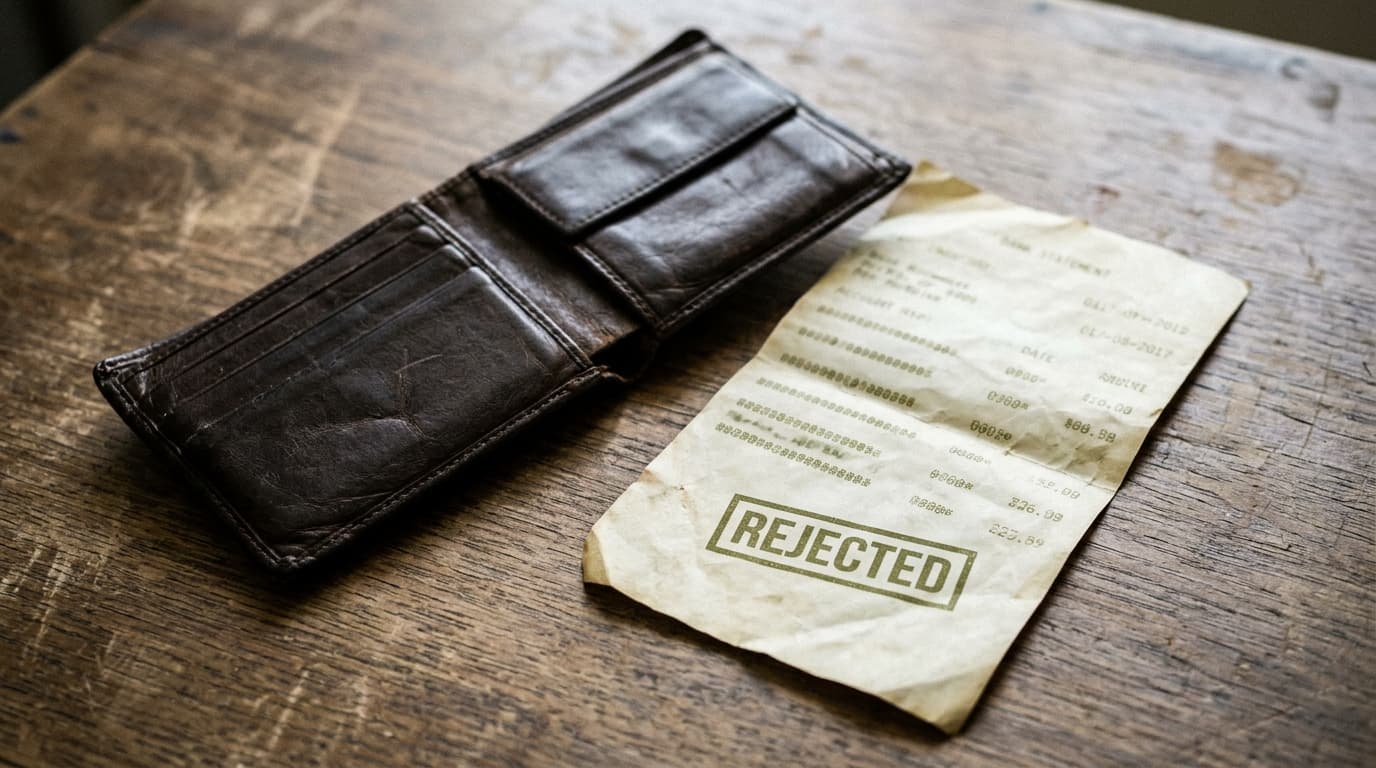
No, a rejected direct debit does not get you listed. It costs money, twice: the card issuer charges for the unpaid direct debit, and your bank may charge for the refusal. A default on the Central Individual Credit Register, the National Bank of Belgium's credit database, only comes after three months unpaid, above EUR 25.
What happens when my credit card direct debit is rejected?
The instalment is not paid, and the late-payment machinery starts. Your bank refuses the direct debit because the balance is too low, the card issuer records the unpaid amount, then it charges.
At Belfius, the account must be funded on the same day before 5 p.m., otherwise the transaction is "automatically refused and fees may be charged", according to its direct debit page. You learn about it through an annex to your account statements. At KBC, a notification flags unexecuted transactions and the app offers to "settle" them.
The rejection does not erase the debt. The issuer keeps it on your card account, interest keeps running, and late interest is added on the overdue instalment alone.
In the files I handled, the question always came in the same order: first the fees, then the fear of being listed. For a single rejection, the listing was almost always beside the point.
How much does a rejected direct debit cost, on the issuer's side and the bank's side?
Between EUR 15 and EUR 20 for a one-off rejection, in the price lists I was able to read. The fees come from two different houses, and that is what surprises people on the statement.
On the issuer's side, the Beobank price list in force from 1 February 2026 sets EUR 10.00 for an unpaid direct debit on its credit cards. It caps late interest at the actuarial borrowing rate multiplied by 110%.
On the bank's side, the same price list charges EUR 8.00 for an unpaid direct debit on a Beobank current account. KBC listed EUR 6.05 per direct debit not executed for insufficient funds in its price communication of 4 July 2022, the last complete version I could read. Belfius announces possible fees, with no amount on the page consulted.
An example, with my own calculations. A EUR 50 instalment on a Beobank Visa, collected from a KBC account. The rejection costs EUR 10.00 at Beobank and EUR 6.05 at KBC. One month late at 15.38% a year adds about EUR 0.64. Total: EUR 16.69, a third of the instalment.
Over twelve months, that comes to EUR 192.60 in rejection fees for twelve EUR 50 instalments, without a single reminder.
Beobank and Buy Way: two cards, two rejection price lists
Rates checked at the issuer on 31 October 2026.
| Card | Annual fee | APR on the carried balance | EUR 100 withdrawal | Unpaid direct debit | Reminder fee | Source and date of the rate |
|---|---|---|---|---|---|---|
| Beobank Visa | EUR 5.00 | 14.49% (credit line of EUR 2,150) | EUR 5.00 (2.50%, minimum EUR 5) | EUR 10.00 | EUR 6.20 or EUR 7.50 plus postage, depending on the contract | price list from 1 February 2026 |
| Buy Way Mastercard One | EUR 17.50 | 14.50% (credit line of EUR 5,000) | EUR 6.50 | not stated in the guide | not stated in the guide | guide of September 2025 |
The Buy Way Mastercard One guide provides for repayment by direct debit at the start of each month, or by transfer before the 1st. Its price page mentions no rejection fee. The EUR 2.00 line you can read there concerns a reminder of the card's PIN, not a payment reminder. Reread your general terms before concluding that a rejection is free there.

Can the issuer stack a rejection fee and a reminder fee?
The law does not say so in those words, and it is the point I would watch. For a credit line, Article VII.106, § 2, of the Code of Economic Law (Book VII is the Belgian consumer credit chapter) limits what can be claimed for a simple late payment: the overdue capital, the overdue cost of credit, the agreed late interest and reminder fees, one mailing a month, capped at EUR 7.50 plus postage.
An "unpaid direct debit" line does not appear word for word in that list. I know of no decision saying whether it counts as a reminder fee or as something else. If your statement shows, in the same month, a rejection fee and a reminder fee, ask for the detailed statement of account and the contract clause behind each one. The procedure is explained in the article on requesting a debt statement.
Your bank falls under a different text. Article 79 of Directive (EU) 2015/2366, the second Payment Services Directive, allows fees for refusing a payment order if the framework contract provides for them and the refusal is objectively justified. The fees must be reasonable. I found no figure-based cap in Belgium, like the EUR 20 set by the French rule that is often quoted.
Does a rejected direct debit put me on the Central Individual Credit Register?
Not on its own. The note from the Belgian Data Protection Authority on the Central Individual Credit Register, updated on 1 July 2018, sets out the criteria of the Royal Decree of 23 March 2017. For a credit line, a default is recorded when an amount due is not repaid within three months. A first default must exceed EUR 25.
Two details from the same note change how you should act. A payment counts when the money is credited to the lender's account, not when you give the order. And an arrangement made afterwards does not change the calculation, which is based on the instalments set in the contract.
The reset to zero follows its own rule. Belgian law requires an open-ended credit line to be fully repaid by a set date; if the balance is not back to zero on that date, recording happens one month later. Buy Way writes it in its guide: use of the card is suspended first, then the default is recorded if it persists. Retention periods are detailed in the article on the Central Individual Credit Register.
What should I do in the days after the rejection?
Pay the instalment by transfer, without waiting for another attempt. The issuer looks first at the date the money reaches its account, not at your good faith.
- Check the exact instalment amount and due date on the last statement.
- Transfer that amount to the issuer's account, with the structured reference from the statement.
- Keep the proof of transfer and note its date.
- Compare the fees charged with the issuer's price list and your bank's.
- Warn the issuer in writing if the next direct debit is also likely to fail.
| Situation | Likely outcome | Useful step |
|---|---|---|
| One rejection, account topped up within the week | rejection fee, a few cents of late interest, no default | transfer the instalment with the structured reference |
| Rejection in the same month as a reminder fee | two fee lines on the statement | ask for the statement of account and the contractual basis of each fee |
| More than EUR 25 unpaid for nearly three months | default recordable on the Central Individual Credit Register | pay the arrears before the end of the third month, in writing |
| Reset-to-zero date passed | card suspended, default one month later | clear the card account before that deadline or contact the issuer |
| Rejection although the account had funds | error by the bank or the creditor | written complaint, refund of fees, then Ombudsfin |
What if the direct debit was rejected although my account had funds?
Then it is not your late payment. Ask your bank in writing for the reason for the refusal, with that day's statement. A mandate badly recorded after a change of account is a frequent cause.
I have read statements where the same instalment carried two fee lines on the same day, one from the bank, the other from the issuer, on an account that was in credit. Each one is disputed separately, with whoever charged it. Without a satisfactory answer, Ombudsfin, the Belgian financial-sector ombudsman, examines the file free of charge, provided you first wrote to the complaints department. Its opinion does not bind the bank.
Direct debit rejected twice: when should I ask for help?
From the second month. A single rejection is a calendar accident. Two rejections in a row point to a budget where the instalment no longer fits, and the fees worsen the problem they penalise.
Simple late payment and its caps are covered in the article on late credit card payment. For the effect of a minimum payment on how long the debt lasts, see the minimum payment. To block or dispute a direct debit, see the article on direct debit or card, and for a budget that no longer allows repayment, debt mediation.
To compare cards on what they cost, the ranking of Belgian credit cards, the comparison tool and the selection guide start from the same checked rates.
Sources, accessed on 31 October 2026. Unpaid direct debit fee on a credit card (EUR 10.00), on a current account (EUR 8.00), late interest, reminder fees, annual fee, APR and withdrawal for the Beobank Visa: Beobank price list, in force from 1 February 2026. Mastercard One annual fee, APR, withdrawal, repayment methods and reset to zero: Buy Way guide, September 2025. Unexecuted direct debit at KBC (EUR 6.05): KBC price communication of 4 July 2022, last complete version consulted. Automatic refusal and cut-off time at Belfius: Belfius direct debit page. Article VII.106 of Book VII: Code of Economic Law in the Belgian Official Gazette. Fees for refusing a payment order: Article 79 of Directive (EU) 2015/2366 on EUR-Lex. Recording criteria for the Central Individual Credit Register: Data Protection Authority note, 1 July 2018. Recourse: Ombudsfin. Fee and late-interest calculations: author, 31 October 2026. No link in this article is paid for.
Comparator
Compare cartes de crédit side by side.
Compare now →
Frequently asked questions

Delphine a passé sept ans au service litiges et rétrofacturation d’un émetteur de cartes belge, à Liège, entre 2015 et 2022 : le bureau où atterrissent les contestations de porteurs, les retraits facturés deux fois et les cautions d’hôtel qui restent bloquées trois semaines. Elle a donc lu, ligne par ligne, plusieurs milliers de relevés de cartes belges, et elle sait où se logent les montants que personne ne regarde avant de signer. Depuis 2023 elle relève chaque trimestre les tarifs publiés des émetteurs belges et tient le tableau de coûts qui sert de base à ce site. Ce qui l’agace : les brochures qui annoncent une carte à 0 € sans mentionner que le premier retrait au distributeur coûte 5 € fixes plus 1,8 % de commission, et que les intérêts courent dès le jour du retrait.