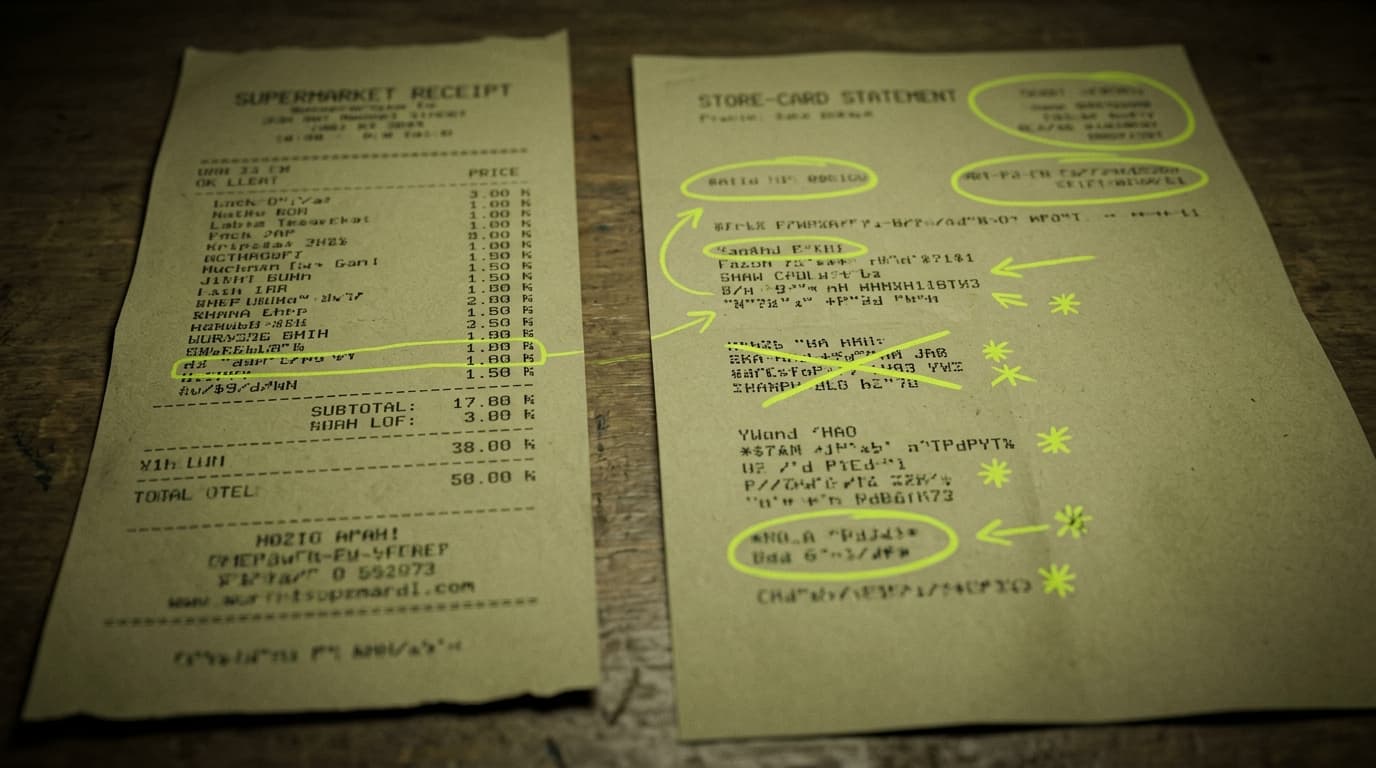
The Carrefour Visa, the Cofidis Mastercard and the Buy Way Mastercard One are three credit lines, not three loyalty cards. They cost little as long as the statement is paid off every month. Once a balance is carried, a charge is disputed or a zero-balance date goes by, the three contracts behave differently, and that is where they need comparing.
Who actually lends you the money behind the store card?
Not the shop. The Carrefour Visa is granted by Fimaser, the Cofidis Mastercard by Cofidis, the Mastercard One by Buy Way Personal Finance. That lender is who you write to when something goes wrong, and it decides whether to refund you.
A detail the checkout will not tell you: Fimaser's comparison of credit types, version 7 of 2026, is served from Buy Way's servers, and both lenders share the same address, Boulevard Baudouin 29 in Brussels. Two brands on the shelf, one building for the back office.
The three figures nobody reads before signing, card by card:
| Card | Lender | Annual fee | APR on carried balance | EUR 100 withdrawal | Rate recorded on |
|---|---|---|---|---|---|
| Carrefour Visa Basic | Fimaser | EUR 0 (card fee of 2.40 % a year on the balance owed) | 16.50 % to 13.50 % by amount | interest from the day of withdrawal | fee 31/08/2026, APR 07/10/2026 |
| Carrefour Visa Classic | Fimaser | EUR 24, waived the first year | 16.50 % to 13.50 % by amount | interest from the day of withdrawal | fee 31/08/2026, APR 07/10/2026 |
| Cofidis Mastercard | Cofidis | EUR 5 | 16.5 % to 13.5 % by amount | EUR 0 commission | 31/08/2026 |
| Buy Way Mastercard One | Buy Way | EUR 17.50 | 14.50 % (EUR 5,000 example) | EUR 6.50 | 07/10/2026 |
The Buy Way amounts come from the Mastercard One user guide, dated September 2025 and checked on 7 October 2026. The retailer card ranking covers fees and rebates in detail; this article deals with what comes next.
How much does a carried balance cost on each of the three?
Between 13.50 % and 16.50 % APR, and the percentage rises as the amount falls. The Fimaser grid checked on 7 October 2026 sets 16.50 % up to EUR 1,250, 14.50 % from EUR 1,250 to EUR 5,000, 13.50 % above. Cofidis publishes exactly the same scale. Buy Way shows 14.50 % on its EUR 5,000 example, for a variable borrowing rate of 13.75 %.
The minimum monthly payment is the same everywhere: 5.6 % of the balance up to EUR 5,000, with a EUR 25 floor. Fimaser spells out a point the others leave out: that percentage is calculated on the outstanding balance "plus card fees". The grid drops to 4.2 % between EUR 5,000 and EUR 10,000, then to 2.8 % above.
Over twelve months, it works out like this. Take EUR 1,000 carried on a Carrefour Visa, at an 11.22 % borrowing rate plus 2.40 % card fees, with no new purchases and only the minimum paid. About EUR 573 is left after one year, and you have paid some EUR 107 in interest and fees. On the Buy Way One, at 13.75 %, the result is almost identical: EUR 574 left, EUR 108 paid. Both simulations are mine, run on 7 October 2026 on the published rates.
The two lines look alike. The minimum is what costs you, not the brand.
What happens when you dispute a charge?
The amount stays on your balance while it is examined, and it earns interest. It was the most common practice in the files I saw, and it is the one that angers cardholders most.
A public complaint filed on the Test-Achats platform, the Belgian consumer association, in September 2023 shows the sequence. Seventeen unknown transactions on a Carrefour Visa, EUR 568.64 in total. A police report on 1 June 2023, a refusal from Fimaser on 22 August, and in between, interest charged on the disputed sum. Fimaser replied by referring the cardholder to its Quality department.
In the files I handled, the first thing I looked for was the dispute letter. Not the phone call, the letter. A cardholder who writes the same day, lists every disputed line with its date and amount, and asks in plain words for those lines to be excluded from the interest calculation during the review, almost always gets at least that suspension. A cardholder who phones three times has nothing in the file.
If the fraud is accepted, the refund is not limited to the capital. The rules on unauthorised transactions require the account to be put back where it would have been without the transaction, interest included. Keep your statements: they prove what you were charged in the meantime.

Is fraud on a store card refunded like fraud on a bank card?
Yes, under the same rules. A supermarket's name on the card changes nothing: it is a Visa or Mastercard payment instrument, subject to Book VII of the Belgian Code of Economic Law and to Directive (EU) 2015/2366, known as PSD2.
Three rules apply to all three lenders:
- your share is capped at EUR 50 for transactions made before the card was blocked, unless you acted with gross negligence or fraudulently (article 74 of PSD2);
- you must report without delay, and no later than thirteen months after the debit (article VII.41 of the Code);
- once the card is blocked, any further fraudulent transaction is borne by the lender.
The documents required afterwards vary from lender to lender. Buy Way asks for the police report in case of fraudulent use, and gives a blocking number open day and night, 02 320 25 95. Write your lender's number in your diary, not on the card. The refusal ground I saw most often does not depend on the shop: gross negligence, raised as soon as the code was given to someone, even by phone, even to a voice claiming to be the bank. The article on refunds refused for gross negligence explains how that ground can be challenged.
What do you risk if the zero-balance date goes by?
Suspension of the card, then a negative record. Buy Way writes it plainly in its guide: if the balance is not brought back to zero by the due date, use of the credit line is first suspended, and if the default persists it is reported to the negative section of the Central Individual Credit Register kept by the National Bank of Belgium.
The zero-balance rule, known in Belgium as "zérotage", is a legal obligation set by article VII.95 of the Code and article 14, § 3 of the Royal Decree of 14 September 2016. The balance must fall to EUR 0 and stay there for at least 24 hours. The date appears on every statement; on the example published by Buy Way, a December 2025 statement shows a zero-balance date of 17 October 2027.
The brochure does not highlight this: paying the minimum every month does not guarantee reaching zero in time. Fimaser and Buy Way both say so in their own documents. The lender must warn you at least two months before the deadline. That is the moment to write, not afterwards.
Where can you turn if the lender refuses?
First its own complaints department, in writing. At Fimaser, the published address is fimaser.sav@fimaser.be, and the Quality department answers at quality@fimaser.be. Buy Way works through the contact form on its website, Cofidis through its customer service.
Then Ombudsfin, the Belgian ombudsman for financial disputes, free of charge. It only takes your file after a written complaint that went unresolved, and only if the lender falls within its remit: check its list before sending. Its opinion is not binding. It still carries weight: in the files I handled, a letter announcing a referral to Ombudsfin often got a file reopened.
| Situation | First step | Deadline | Recourse |
|---|---|---|---|
| Unknown purchase or withdrawal | block via the lender's number, then a letter | without delay, 13 months at most | Ombudsfin |
| Interest charged on a disputed amount | letter asking for the lines to be suspended | as soon as you dispute | Ombudsfin |
| Zero-balance date out of reach | letter to the lender, repayment plan | before the zero-balance date | debt mediation, CPAS |
| Monthly payments too heavy | letter to the lender | before the first late payment | debt mediation |
Three figures and two addresses to note before signing at the till
The annual fee, the APR on a carried balance for the amount you are granted, and the cost of a EUR 100 withdrawal. Then the lender's blocking number and its complaints address. If the card sleeps in a drawer, cancelling it is free and removes it from your credit file.
To compare cards on their figures, the ranking of Belgian credit cards, the comparison tool and the choosing a credit card page start from the same recorded rates. The difference between APR and borrowing rate is explained in the article on APR versus borrowing rate.
Sources, checked on 7 October 2026 unless stated otherwise. Fimaser, comparison of credit types, version 7 of 2026 (APR by tier, minimum payment, zero-balance rule, termination). Buy Way Personal Finance, Mastercard One user guide, September 2025 (annual fee, representative example, charges, zero-balance rule, blocking). Fimaser annual fees and Cofidis rates recorded from the issuers on 31 August 2026 for the retailer card ranking. Test-Achats, public complaint "fraude carte Visa carrefour", September 2023. Directive (EU) 2015/2366, article 74. Book VII of the Belgian Code of Economic Law, articles VII.41 and VII.95. Royal Decree of 14 September 2016, article 14. Federal Public Service Economy, maximum consumer credit rates. Recourse: Ombudsfin. Twelve-month simulations: author's calculation, 7 October 2026. No link in this article is paid for.
Comparator
Compare cartes de crédit side by side.
Compare now →
Frequently asked questions

Delphine a passé sept ans au service litiges et rétrofacturation d’un émetteur de cartes belge, à Liège, entre 2015 et 2022 : le bureau où atterrissent les contestations de porteurs, les retraits facturés deux fois et les cautions d’hôtel qui restent bloquées trois semaines. Elle a donc lu, ligne par ligne, plusieurs milliers de relevés de cartes belges, et elle sait où se logent les montants que personne ne regarde avant de signer. Depuis 2023 elle relève chaque trimestre les tarifs publiés des émetteurs belges et tient le tableau de coûts qui sert de base à ce site. Ce qui l’agace : les brochures qui annoncent une carte à 0 € sans mentionner que le premier retrait au distributeur coûte 5 € fixes plus 1,8 % de commission, et que les intérêts courent dès le jour du retrait.